
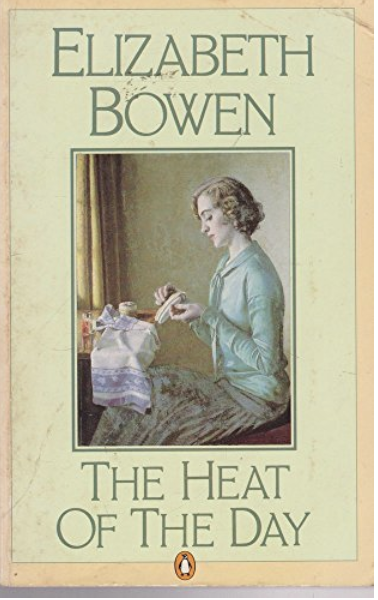
Reading The Heat of the Day by Elizabeth Bowen, I was stopped short by this sentence:
“As against that, Cousin Francis was safely dead, so could not be asked – or rather, could be asked, as often as Stella chose, and could be relied upon not to answer.”
It’s easy to feel constrained about asking a question. It’s easy to feel vulnerable. I’m revealing my lack of knowledge or understanding. Like walking into a new social situation, when it seems everyone else knows what they are doing. If I have to ask, they will see me as inferior or an outsider. And I may have no right to ask: I may be trespassing. So much depends upon my expectation of the auditor. Are they friend or foe? Is the extended hand to welcome me or check me? Even attack me?
A good teacher, of course, creates a space where the asking of questions is welcome. They know questions are useful, help the teacher know whether the student is making sense of what they are being taught and what gaps in knowledge they should address. A question is an insight into how the student is thinking. Any revelation of misunderstanding, ignorance, or curiosity, is welcomed as creating an opportunity. And the good teacher often says ‘you won’t be the only one thinking this.’ They dispel the sense of isolation.
This is emotional hospitality.
I was told, once, in a relationship, “You can ask me anything.” Even now, the memory engenders a warmth in me deep in my core. To say such a thing! It is laying oneself open, like giving a spare key to the house and saying “it’s all there before you and I trust you.” It is transformative: the space becomes safe, the faults, flaws and mis-steps of my questioning will be handled gently, for I am welcome. It’s an ideal which remains bright in the firmament of my memory. (It proved unachievable in the relationship. We aim for stars, we don’t reach them.)
So, back to the quotation, I admire the admission that Cousin Francis’ silence is a relief. Since many of the issues about asking a question are connected with how we feel about the person we are asking, it follows that, sometimes, taking that out of the picture can make things easier. Cousin Francis is, at least, both safe and reliable. Being dead places him out of range; question and answer are decoupled.
A question isn’t merely an arrow whose sole purpose is to hit the target. Sometimes the more significant act is framing it. It’s the slow drag up to the highest point of the funfair ride. Everything that follows is momentous but also, sort of, inevitable. The hard work lies in getting there.
I believe that all the external dangers of asking a question out loud are often mirrored internally in my own inner landscape, my own – does this sound too daft – my own inner society. I must create an emotionally hospitable space for myself, in which to stumble and falter and mis-step.
I think framing a question, finding the words, finding what feel like the right words, is liberating. It’s taking a pile of things and making something from them. Shifting stuff out from the corner into the centre of the room. I seek to shape my thoughts and feelings into something more focused, something I understand better and can do something about. This is what I don’t understand. This is what I am worried about. But it’s also challenging and can be upsetting: it’s entirely likely that I knock into bits of me that hurt, startle myself, venture into places where I feel like my own trespasser. If the question has any depth or import, it’s almost necessary I do this: otherwise I’m simply reinforcing my own assumptions, avoiding my own weaknesses, colluding in my own self-deceit.
This is what I have decided I need to know. It is like finding the key to open a door. Maybe even forging the key to open the door. Sometimes the implications of asking the question are frightening. “Am I up to doing this job?” “Is my partner being unfaithful?” I also believe I can choose whether to use the key. It’s my key. I’ve found it. Or made it. The next step – asking the question or, to switch the metaphor back again, fire the arrow – may be tremendously daunting. Terrifying, even.
Sometimes we see an archer approach the line, take their stance, raise the bow and start to draw the string towards them. And then they pause. They are not ready. Their preparation has bred in them an instinct to sense when something is not right. They step back.
The practice is not wasted. I choose whether to loose the arrow. The next time the archer steps up to the line, each rehearsal has made them stronger and more capable. If, when the time is right, they shoot with accuracy. As Hamlet says, in a different context, the readiness is all.

