
After a few years of ignoring the flaking paint and a pervasive drop in temperature as one enters our kitchen, we have taken a deep breath, drawn ourselves up to our full height as responsible adults, and are “having the damp seen to”.
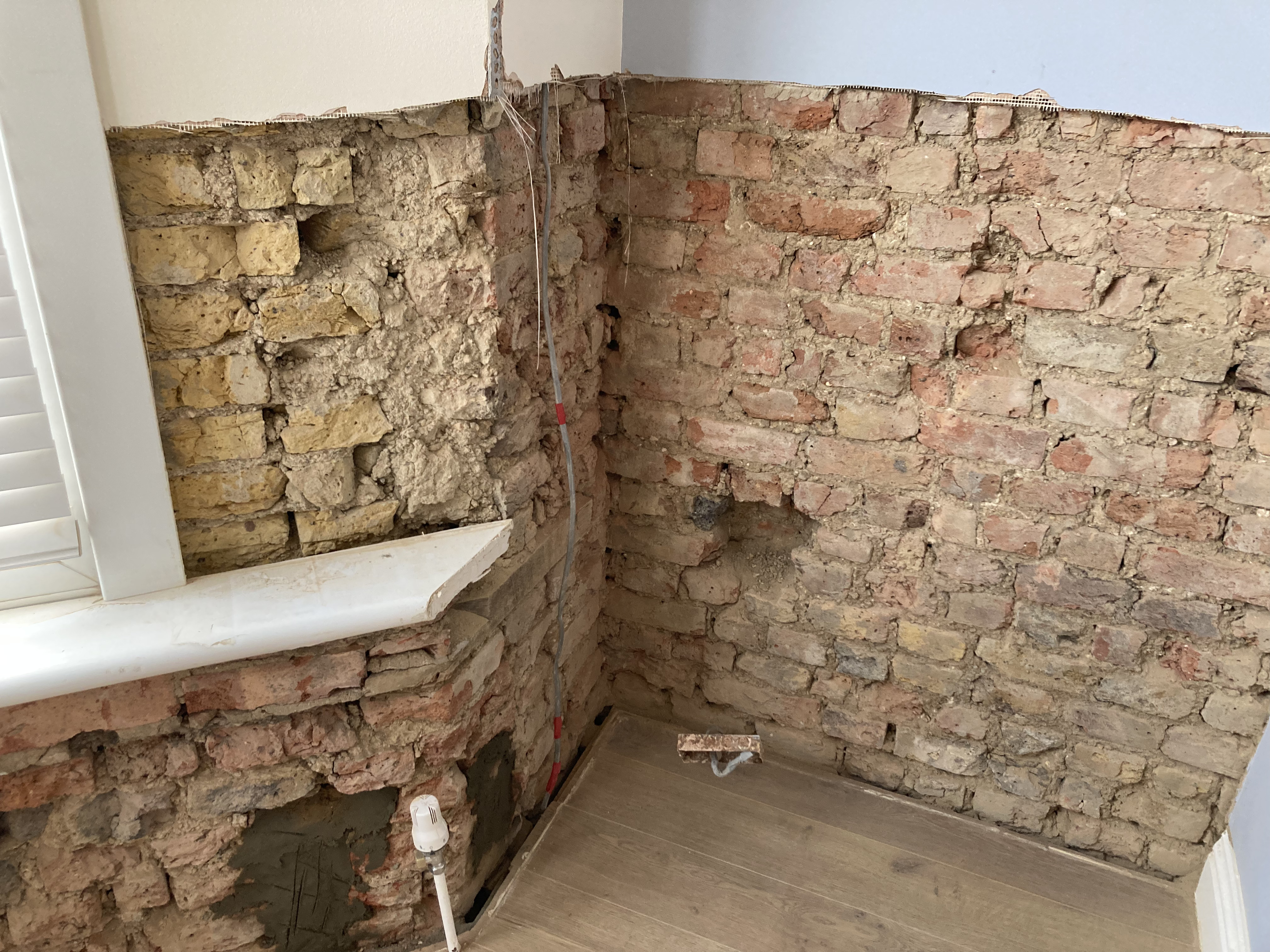
We have some experience of building works, from when we lived in Hampshire. I thought I knew what to expect in terms of noise, dirt, disruption and dust – and all of that is, frankly, quite demanding enough. What I hadn’t anticipated was just how brutal the first stage of the work is: removing the plaster to expose the brickwork.
The damp men cometh. They have seized my home and they are tearing it apart. It’s been shockingly brutal, an assault which makes my dear little house feel fragile. This house has been my shelter and safe harbour. It held me safe when my reality was blasted apart. It is a space which has symbolically provided integration, honesty, wholeness and new roots. It is my nest.
It does not, of course, help me that all the working team are male. The symbolism becomes almost instrusively obvious.
There is a deep level at which I find this very frightening. By commissioning this work, inviting these workmen in, I fear I have invited destruction. I feel I have betrayed my little house and laid it open, vulnerable, and I fear it will not survive. And where will I be then?
Then there is a rational level, where I cling to the understanding that this is just part of a process. It’s necessary to remove the damp plaster; it’s essential to get down to the brickwork in order to apply the damp treatment, and then the walls can be replastered and – in that wonderful tradesman’s term – made good.
And of course this shape of story is familiar. We must tear down before we can rebuild; we have to go through the Slough of Despond before we can head towards the Celestial City; we must die in order to be reborn. I must have faith.
I suppose I had hoped that the story had already reached its end. That the house we had bought was as sound and good as its bright paintwork suggested and I could now live happy ever after. Just as, in a relationship, I had hoped that – having gone through the crisis and started afresh – the past would be ever behind us and everything now would be new, clean, wholesome and lovely.
But we live in an old house, carrying its past with us, in the mess under the floorboards and the botched electrics hidden in its walls. If we wanted none of this, we should have bought a new house (just as, my friends might easily say, I should have looked for a new relationship). Yet new-builds come with their own vulnerabilities and problems. Secrets are built into houses with every trowelful of mortar, right from the start. Localised choices, compromises which set in place a future problem to be uncovered and – as every tradesman has always said from time immemorial – later condemned as appalling practice which the discoverer cannot imagine themselves ever doing. No house (no-one) is created flawless.
The skill now, therefore, lies in judging how far the dismantling can go – how much can be borne – until we say “This. This is enough”. We want the decision point to be obvious – to uncover a level which is strong, stable, sound. Hurrah! But often that’s not the case. Our house is over a hundred years old and the brickwork we are revealing is venerable. The wonder is, to misapply Lear, how has it endured so long, and it calls forth from me admiration, affection and protectiveness. We will rebuild on flaws, fissures and weaknesses. We rebuild from compromise. We rebuild because we cannot bear to dismantle any more and because we refuse to condemn. If we can find a level which is viable, then I will challenge myself to accept and make my peace with what we have. It’s a matter of accommodation.
I’ve been reading, recently, a book called The Lady’s Handbook For Her Mysterious Illness. It’s a hugely wide-ranging book and one part draws on mythical traditions also described in Women Who Run with the Wolves. Feminine myths are not just stories with women as the main characters, it’s more about the shape of the story. I was reminded that, while we often long for narratives to be linear, it’s often more helpful to recognise how life is cyclical. Which should appeal to me, with my love of recursion. The story is never over.
The house will never be finished. But it won’t always be like this. This stage will pass: the workmen have just completed the hacking off and treating the brickwork; we hope to hear from a plasterer and electrician soon and learn when the repairwork can start; there is yet the matter of the kitchen floor. I need to pace myself through this and learn to wear well. It is not a simple question of “how much can I endure?” The more fully, richly and, perhaps, the more willingly, I engage with my difficulties, the more I will learn, the more I can do, the stronger I will grow. And so, wth bittersweet inevitability, the more I can bear.
In the absence of happy-ever-after, I will try to accept more graciously the never-ceasing cycle of changes and challenges and enjoy what I can. Time and age will continue to show their effects. In a few weeks, there will be an end to this chapter about the damp work, but it will not be an end to the story of me and the house.
 lesleyjonesberry
“We must tear down before we can rebuild; we have to go through the Slough of Despond before we can head towards the Celestial City; we must die in order to be reborn.” And the Hero must descend into the Underworld.
Also: wabi-sabi. Nothing lasts forever. Nothing is finished. Nothing is perfect.