
I have been thinking about confidence.
Last night I met two friends for cocktails and a catchup. I find this a little daunting: I love having friends, but my emotions stutter when navigating the social route – the practical arrangements, conversational balance, how long to stay, what do they really think of me, all of that. When I have done it, I am glad I did, and I know I’ve enjoyed so much of it. I feel immensely soothed, validated and eased, and I hope they feel something of the same. But beforehand, as the event approaches, I never want to go.
Going out, on a Friday evening into Soho, takes a form of confidence. I manufacture this by thinking about what I wear, trying to look as good as I can, not being rushed, and making sure my bag is big enough to carry a book (a book is a portable magic door, an escape route if I need it). And huge thanks to the four guys – homeless probably, addicts possibly, a little drunk almost certainly, gathered in a Covent Garden sidestreet doorway. As I walked past, one noticed me and complimented my dress, and then – like passing round a tinny from which they all took a sip – praise rippled through the group. These things – their goodwill and also the whole evening – make me feel good, validated, a little more assured about my decision making. Yes, I will go out, yes the dress was a good choice… a sort of “See, Lesley, you can do this”. And it makes me feel more capable for the future, since, next time, as the anxiety grows, as it almost always does, I remind myself. “See, Lesley, you have done this”. Suddenly, oddly, I am reminded of Othello’s final words:
Say besides that in Aleppo once,
Othello Act V Sc ii
Where a malignant and a turbaned Turk
Beat a Venetian and traduced the state,
I took by th’ throat the circumcised dog
And smote him thus.
I think Othello is nervous about what he is about to do and reminds himself of the past, to make himself capable of action now. “See, Othello, you can do this.” But also, as the Spark Notes put it “Othello seems to have calmed himself and regained his dignity and, consequently, our respect”. He is restored to the noble warrior portrayed at the start of the play. This is confidence. It’s not just outward appearance or capacity to function in the outside world. These are its manifestations, but not it. Confidence means having full trust. Literally ‘with faith’. Congruence, knowledge and ease with one’s self.
And what is self? Some sense of internal identity, a continuous coherence which is formed within me, as well as experiencing all the living scattergun moments. A capacity within my consciousness, a perspective – ‘stepping back’ – to consider, evaluate and care. The ‘I’ that I place in a sentence when I speak or write. And then religious language comes to hand, for what I tend to here (pay attention to and nurture) is perhaps my soul.
Confidence means I am able to say – as I have had to recently – “I don’t like the way I have been behaving”, “I feel like I am becoming someone I don’t recognise”. It means I can look at my behaviour, and reject it as “not me”. I can turn, return towards – as Polonius exhorts – being more true.
I wonder whether the opposite of confidence is anxiety. Being ill at ease with oneself, so all the external markers, all the scattergun moments, buffet a self which, not being securely tethered, is pushed hither and thither, overwhelmed by thoughts and feelings. Just as confidence is strengthened by drawing on ‘successes’, so is anxiety amplified by past failures. It ensnares and gnaws at the soul, drains and exhausts, takes all our energy and wastes it. It paralyses our capacity to decide, determine, diagnose and care for ourselves. It is the antithesis of confidence, which generates – re-generates – energy and momentum, makes everything swifter and clearer. Nurturing confidence is a careful, continuous responsibility. I am my own precious cargo.
I’d like to be a better me: I’m disappointed in my under-achievement, I am at times frustrated by my own timidity but, at core, I’m happy that ‘being Lesley’ is my life task. I’m reconciled to myself. Content with my content. And fortunately, trying to be a better me is exactly the opportunity which lies before me. I will still make mistakes, but they can be whole-hearted ones. I’ve made such mistakes in the past and, without doubt, I’ll make more. As long as they are mine, in a self I can own and recognise, then I’ll live with that.
I have a fondness for the novels of Mary Wesley, her economy of prose and, yes, the confidence of her characters. Not That Sort of Girl charts the thoughts of recently-widowed Rose. We meet her a few days after her husband’s funeral, as she is about to leave the house to spend a short time alone and reflect on her life:
Nicholas left the room.
Rose sat on in front of her mirror, her hands in her lap. Looking deep into the glass at the reflections of the room, she murmured, ‘You. I’ll take you.’ She got up and took from the wall a small picture and, after wrapping it in a nightdress she took from a drawer, put it into an overnight bag, padding it protectively with underclothes and jerseys. Then, fetching her washing things from the bathroom and adding them to the bag, she zipped it up and left the room without a backward glance.
Rose doesn’t know what she is going to do next, but she is effective. She knows herself, what she needs right now, she is unencumbered, nimble. That’s what confidence looks like.
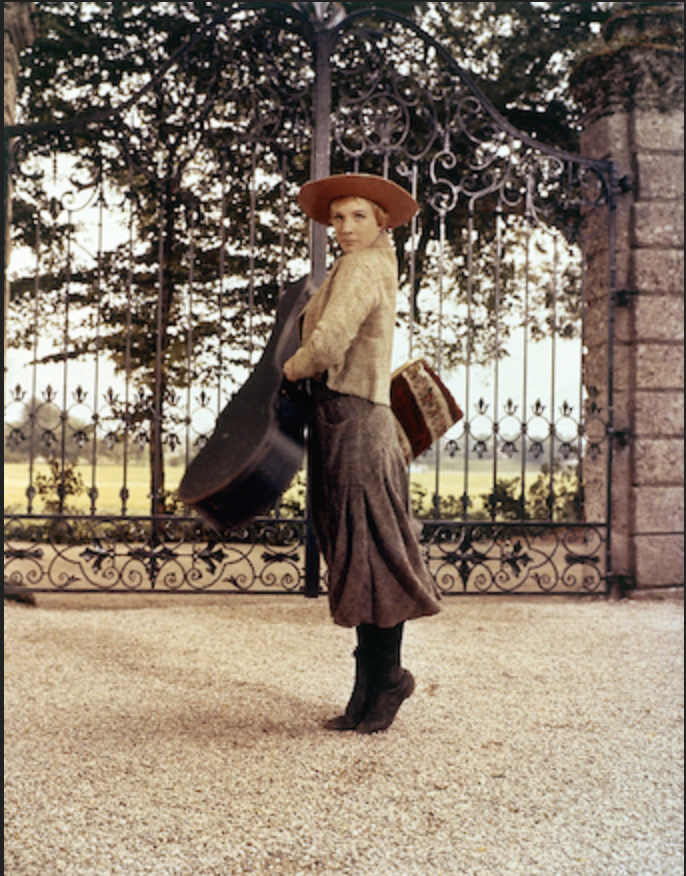
Ah, how have I got through this without mentioning Julie Andrews? Ignore everything I have written and watch this instead, it’s sheer delight.
 lesleyjonesberry
Have you ever been out in public with everything going fine, and suddenly out of some dark alley you are mugged by anxiety?
For me, it’s more often the brick wall of fatigue, the classic introvert/sociability problem. It’s not anxiety, I suddently feel ‘however lovely these people are and however fond I am of them, I am socially ‘full up’ and need a break’. That’s a different issue.