
Sometimes I dream of being in a familiar house, opening a door and finding a forgotten room. This is a common dream theme, a recurrent trope. The discovery brings with it with a strange small mis-step lurch of emotion: how can I have overlooked this so completely? To mis-apply Eliot, we ‘know and do not know’ the space: it is both a new, fresh opportunity and also restoration of something long lost. It’s slightly magical. Eliot again:
Footfalls echo in the memory
TS Eliot Burn Norton
Down the passage which we did not take
Towards the door we never opened
In the dream, as in the poem, this time we follow the path, we open the door or, in my case, we climb the staircase.
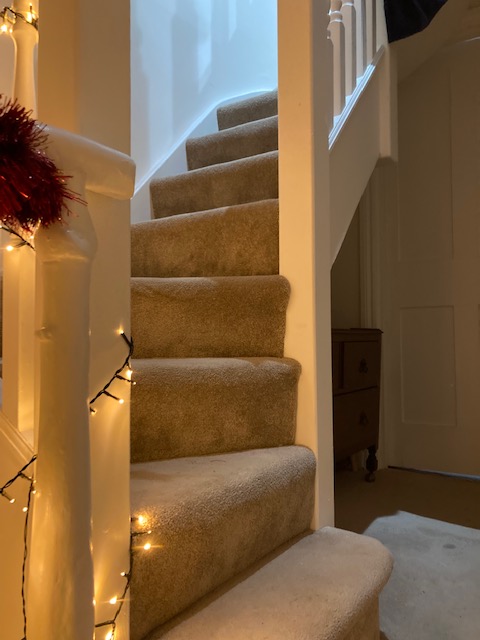
When we viewed the house we now live in, the room plans had been freely available on Rightmove, so the layout was, it should have been, as expected. Until we reached the first floor landing. A narrow twisted staircase – not quite a spiral – leading ‘further up and further in’. It led, of course, to the attic – restricted headroom and pitched roof going down to the floor but, plastered and painted and carpeted, with both skylight and electric light, it was also, very nearly, another room. ‘We used it as a playroom’, the owner said casually. ‘Not a proper conversion: it can’t be used as a bedroom’, said the solicitor. ‘Too small for me to stand up in’ said my very tall husband. A dream come true, I thought.
Personal space is very important. From a child to a young adult, I had the same bedroom in my parents’ house: first shared with my brother and then all to myself, and it became the guest room to which I, and my husband, and our children, returned when we visited. It remained a palimpsest of memories and identity: I could still, can still, remember fragments of long-replaced wallpaper, overlaid as new eras were marked – childhood, teenage years, adulthood. Furniture was rearranged, posters put up, bookshelves added. Once I had moved out, the room gently anonymised into a guest room, but when I returned, still I knew the spot on the wall where the cat hid under the chair on the nursery wallpaper.
As you grow up, if you fall in love and become part of a couple, learning to share space is part of the thrilling experience of intertwining two lives. And then – if children follow and as households change shape – the family unit grows and the sharing increases. In one sense, the space you possess as an adult gets bigger and bigger, you ‘have it all’, but at the same time it becomes less exclusive. I wonder if this is something women feel more strongly: as wives and mothers they become responsible for a household and for the general maintaining of all this space. Family life – shared, messy, compromising, sustaining family life – offers such riches but – well, shall we just say we can feel that we have had to spread ourselves very thinly.
When the children were primary school age, my husband did a full-time residential MA course. A career in the Navy meant his being away was not uncommon, but I was taken aback by a sharp pang of envy, as we (myself and the children) left him in a neat, anonymous student-y room with nothing but bed, desk and shelves for books. A space just to live and study, to read and think. Not shared by anyone else. It seemed to me then, I believe this is, the most glorious luxury.

I’ve written about my love of liminal, accidental spaces before. With an imagination largely created by children’s fiction, I find attics are, of course, high on the list, somewhere between treehouses and wardrobes: they are places of secrecy and discovery, of refuge and dreaming. I once saw a production of As You Like It which began in the attic, that no-man’s land of memories, in a monochrome space which transformed into the green forest of Arden. I’ve never seen a better production: Arden was real and imaginary, an emotional space as well as a physical one – exactly as theatre is, simultaneously in and out of this world.

Virginia Woolf famously stated that ‘a room of her own’ was a necessity for a woman to be productive in her own right – although Jane Austen, made of stronger stuff, managed with just a table in the corner of the sitting room. I can’t offer any ambitions to be productive in the way that the world might recognise. Nonetheless, claiming this space is hugely significant. A space to be able to think and work and write. Surrounded by old toys, boxes of memories, shelves of books, a piano and a desk. A space to reconnect, reflect, repair and restore; a place to grow and strengthen and, just possibly, create. My personal space.
 lesleyjonesberry
Beautifully written as always, I believe you will create in this space.
Pingback: Hacked off | lesleyjonesberry