
 Christmas is approaching: every shop, magazine and TV advert tries to persuade us that an illusory Christmas can be ours if we just spend money on a particular gadget, fragrance, food production, type of alcohol or whatever. Yesterday, I suppose I succumbed: I spent a completely indulgent amount of money and, what is worse, on a Christmas present entirely, selfishly, for me.
The knock on effect of everything starting so early is that the Day itself seems the termination of Christmas activities. Before the turkey carcass is cold, everything is marked down for the sales, the tinselly seems tawdry, and the lights are all put away. Long ago, in medieval times and through to Elizabethan, Christmas day was the start of feasting and festivities which continued for nearly a fortnight: the twelve days of Christmas during which the beleaguered true love has to set up an impromptu bird sanctuary and so on. Indeed, speculation has it that Shakespeare’s Twelfth Night was written to be performed as part of these celebrations, hence its title.
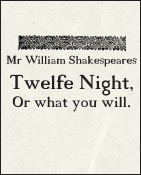 Is Twelfth Night a Christmas play? Not obviously, although a key element in many medieval celebrations was the disruption and inversion of normal social order. A lowly member of the household might be appointed King of the Feast, either at random (whoever found the token in their cake) or by deliberately choosing the youngest, least important member of the household, and with, as it were “hilarious consequences”. Twelfth Night draws upon these themes of misrule and disorder, most obviously in Malvolio the steward who is tricked into declaring his love for his Mistress. In choosing the steward, Shakespeare chose a figure ripe for ridicule from both the groundlings and the gentlemen in their theatre boxes. Imagine Carson from Downton Abbey being tricked into proposing to Lady Mary. “Upstairs” would find it hilarious because he is only a servant; “Downstairs” would find it hilarious to see someone in such authority over them made a fool of; and everyone finds it funny because he is pompous and over-wedded to his sense of his own dignity.
Disguise and music were also key elements in the seasonal celebrations. Twelfth Night has some of Shakespeare’s most beautiful lyrics and I have been amazed how, in different productions, Feste’s songs are reborn fresh and moving. In Feste, of course, we have perhaps my favourite character in all of Shakespeare. Certainly the first I fell in love with: clever, perceptive, wise Feste, disguised as a fool. I also love the fact that one of the main characters disguises herself so well throughout the play that we, the audience, do not know her name until it is restored to her by her brother in the final scene. Nowadays we have programmes, if not foreknowledge, to tell us. But just imagine being in that first audience. We are so drawn into this character’s experiences, but we have no name for her – nothing to label or define her. She (he? she?) remains an enigma and unfixed, beyond our grasp. ‘What’s her history?’ ‘A blank, my lord.’
It is a truly great play. The first recorded performance was in 1602 on February 2nd (it’s recorded in John Manningham’s diary) but it is very possible that the play was performed earlier, on January 6th in 1601. I have been brought up to believe that this is, indeed “Twelfth Night”, the day when Christmas ends, the decorations come down (and the chocolate ones finally eaten from the tree), the last day of celebration.
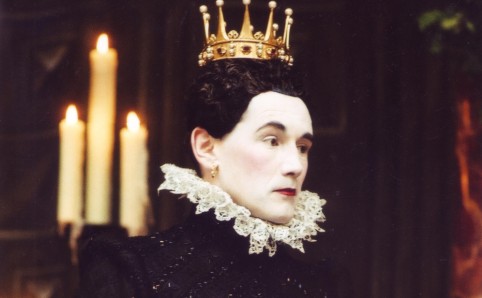 So what am I going to do on Twelfth Night this Christmas? I am going to Twelfth Night, on what might be the 412th anniversary of its first performance, to an all-male, authentic practices production – that amazing Globe Theatre company, from the summer, led by Mark Rylance and including the adorable Sam Barnett. Short of actual time travel, I cannot imagine anything more exciting. Yes, of course, that’s my indulgent selfish Christmas present. And I am sorry, I can’t feel guilty about it. I think I am going to just love it.
 lesleyjonesberry
Sounds perfect for you, doesn’t seem indulgent at all. The religious season of Christmas does indeed go on to 6th January when it seamlessly joins to Epiphany( in the Orthodox church the main feast is celebrated on this day). The word Epiphany comes from the Greek for ‘showing forth’ thus throughout Epiphany we have stories in which the full stature of Jesus is revealed- his baptism ( this is my beloved Son…), water into wine as well as the arrival of the Magi. So in Twelfth Night Shakespeare takes the theme of this new season and by the end of the play reveals Viola’s true identity and many other things besides. Nice one Will! Enjoy