
I’ve been thinking about kissing recently, in part because of a story I’m writing. We give kisses, and we receive them. “En amour, il y a toujours celui qui donne les baisers et celui qui tend la joue” as the idiom goes, or possibly Balzac actually wrote at some point.
Kissing, says Balzac (if it were he), is always a one-way act. There is an agent and a recipient. Relationships, he suggests, are never equal: one person is always more affectionate than the other; there is always one who loves more. I’ve then always understood that the greater power lies with “celle qui tend la joue”. My image is of a courtly woman, reclining on a chaise longue, arm outstretched along its satin-embroidered back, who permits the supplicant to approach, and grants this one moment of close contact. As the aspirant lover approaches, the woman turns her head a little – to present the cheek more readily but also, in the same gesture, turning her own mouth away. The movement carefully denies, even as it grants. She permits a single peck on the cheek, from which the lover withdraws, trembling. In physical terms, so little occurs, but its significance is intense and immense.
Another picture I have is of the haughty parent who requires the cowed child to demonstrate their affection. I bet King Lear demanded his daughters kissed him and, at the same time, expressed it as if granting a boon. “You may kiss me,” he would say, sitting majestic on his elevated throne, and the chosen daughter ascends the steps, approaches submissively, curtseys as she retires. The monarch sits unmoved and unmoving throughout.
Contrast these scenarios with the kisses we give to a baby or a small child. The peppering of kisses which transform themselves into blowing raspberries against the skin – preferably on the tummy – and make the recipient squeal with glee. There is one who kisses, countless kisses, freely, demonstratively. And that feels much more fun.
I grew up in a fairly undemonstrative family. I cannot remember kissing my parents when I was a child, although I am sure they kissed me good night. After I had grown up and left home, I received a phone call that my father was in hospital. I resolved that, if he were alive when I got there, I would kiss him on my arrival. And I did. And I continued to kiss him, when we met and when we parted, across the years thereafter and I am glad that I did so. I learned to hug and kiss my parents and they, I think, adapted happily to the change. When I visited them with my children I saw with pleasure how my mother was easily affectionate with them and, with possibly even deeper joy, how my dad learned to be physically at ease with them. It took him time. I do not know enough about his childhood but I do not think there were many hugs or kisses.
Hugs are not kisses, but they are adjacent. They dwell in the middle ground of physical contact which signifies and conveys degrees of closeness and degrees of love. And here we must also talk of the importance of where the kiss lands. It matters, of course, whether the kiss is on the cheek, or the hand, or the top of the head, or on the lips. Balzac’s cheek is, as it were, a bit of a put-down in itself, if the encounter is between lovers; it generates the power dynamic it is supposed to illustrate.
I do not want to be the one who offers the cheek. That does not mean I do not want to be kissed.
All sorts of social and familial conventions come into play: in some cultures, kissing is common. It’s also not uncommon for 18th and 19th century English novels to have incidents where the kissing of a young bride seems to be a free-for-all social activity. Such moments read very oddly to me, increasingly so now, with questions of consent, especially as I don’t find any equivalent passages where all women in the same society home in for a quick snog with the handsome young groom.
Lips are intimate. I do not know (and I am not prepared to Google) whether the idea that prostitutes do not kiss their clients has any basis in practice, or merely comes from Pretty Woman. If it has some truth to it, I recognise the pragmatic reasons. I don’t know much about prostitution but I have been to a series of lectures by Chris Whitty about disease transmission. Even so, there remains a symbolism to the kiss which holds good: a kiss is the symbol of love.
And so, we long to kiss and be kissed, just as we need to love and be loved. How can we communicate that, and negotiate it, with another? How do we know if the kiss will be welcome? Well, we don’t, although, if we attend, there will be signs and indications which will give us confidence. And if we are mistaken, that’s the moment to retire gracefully.
There is a huge difference between offering and requesting a kiss. “Can I kiss you?” is the offer. As is (perhaps a little more hesitantly) “may I kiss you?” “Can I have a kiss?” is a request, with an odd mix of importunity and passivity. “Give me a kiss” comes in the voice of the drunken lech. “Kiss me” is demanding but it also suggests that a high degree of urgent reciprocation is on offer: Catullus famously says “Da mi basia mille” which is a very big ask, but he’s clearly happy to match like with like – “dein, quum milia multa fecerimus” – “when we have performed many thousands.” Taking (or stealing) a kiss, by the way, is even worse than requesting and, in my opinion, it’s right out. Like counting to five when you are holding the Holy Hand Granade of Antioch.
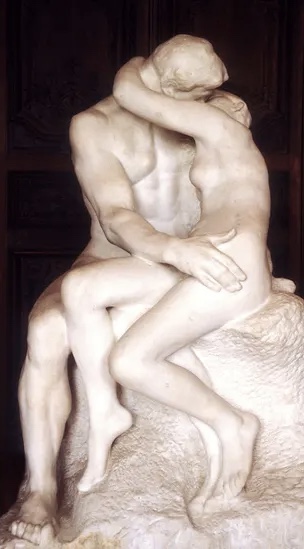
So, Balzac, I’m just not sure about “one who kisses and one who offers the cheek,” but I do think there is one who steps forward and offers the kiss. And I think Balzac is wrong. To offer a kiss does not necessarily generate a dynamic where the other inevitably assumes more power. We can offer a kiss as part of a deal. Deal, Middle English del, from from Old English dæl is “a part or portion” and, later “arrangement among a number of persons for mutual advantage.” A deal is for mutual benefit. And the verb, Middle English delen, “to share with others, bestow, dispense,” and also “take part in, have to do with.”
How we deal with someone (or how we make a deal with them) is how we bestow, how we share something, how we do something in conjunction with them. Which is really what a kiss wants to be. Both offer and invitation. Like love, a kiss is, ideally, given and received at the same time, welcome to both parties, joining them in something shared and for mutual benefit.
Someone has to start it, that’s all.
 lesleyjonesberry