
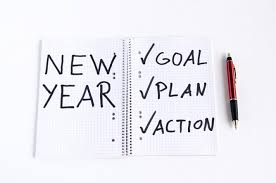
There was a period of time when I tried to encourage the family to make New Year’s Resolutions. These were modest in ambition, often the usual ideas of eating more healthily or exercising more. I also liked to set a personal resolution to try something new – I decided to start this blog at the start of 2012. The family didn’t share my turn-of-the-year enthusiasm: my husband started to react with aversion, while the children, ah, children grow too quickly to be limited to a single moment in the year for a fresh start. My mundane suggestions fell far short of their aspirations and rapid rate of change. Shedding old attitudes as carelessly as they discard dirty clothes on the floor, trying on new ideas and personalities as if from a dressing up box, all this is part and parcel of being young.
This year, undaunted, I returned to the idea and, of course, I looked at the word itself. Where does ‘resolution’ come from?
‘Resolve‘, ‘resolute’ and ‘resolution’ all contain the same root. They are all from the Latin resolvere (past participle resolutus) – “to loosen, loose, unyoke, undo; explain; relax; set free; make void, dispel.” Yet the words now have associations which are completely contradictory to those meanings. The word cluster of resolution, resolve and resolute is all about strength, firmness, fixity and determination. How did they come to be turned around so radically to become, almost, antonyms of their original sense?
Etymonline tells me it all happened somewhere around the early 1500s, when the idea of resolving something – loosening it, taking it apart – became linked irrevocably to a metaphorical use, as a method to gain full understanding. To resolve is to analyse something by reducing it to its simpler, essential component parts. This approach results (in the 16th century mindset at least) in a thoroughness of comprehension, and thus an answer, in which one can have great confidence. Hence a person who is resolute can be depended upon, if someone resolves upon a decision they will not change their mind, and if a resolution is passed, it is a firm and formal agreement. The impact and peculiar force of the words depend upon – contain within themselves the assurance of – the process which has gone before.
In all cases, this isn’t a momentary conviction: I can’t expect to resolve upon something in an instant, or become resolute on an impulse. And, in a more timely application, one can’t make a resolution – not a real resolution – on a whim at midnight on New Year’s Eve. To merit the name of a resolution, it needs to be underpinned by self-reflection. In order to, in a striking phrase from the Etymonline entry on Resolute, “arrive at the truth of it,” I need to dismantle myself.
‘Dismantle’, meaning to take apart, is a metaphor of taking off a cloak, of unrobing. I am reminded that a mechanic might talk of ‘stripping down’ an engine, to clean and restore it and there is a bracing workmanlike attitude about that which is very encouraging and positive. And, surely, isn’t this how an apprentice mechanic becomes more skilled? We learn by taking things apart, it helps us understand how they work. It is often the only way to fix something. Removing the layers from myself, however, and peering into my own soul’s depths is a less comfortable prospect. And I recognise that, for some, it is a huge, sometimes frightening challenge. Nor do I really believe there is any absolute ‘truth’ of myself to be reached. At least, to be honest, if I could reach it, I am not sure how bearable that would be. The Christian faith equates such self-knowledge with being in the presence of God: For now we see through a glass, darkly; but then face to face: now I know in part; but then shall I know even as also I am known. (1 Corinthians 13v12). But it’s only the prelapsarian Adam and Eve who could be naked and not ashamed.
More approachably, another image which came to mind was Lego. Sometimes, when playing with Lego, unbuilding is nearly as enjoyable as building: learning something of the logic with which a construction was put together; seeing how one particularly-shaped piece has been used in different, ingenious ways; the satisfying orderliness of sorting into component parts; sometimes, the relief of thinking “that wasn’t very successful, let’s try again” and releasing all those pieces, undamaged and reusable. I can take apart and rebuild exactly the same, or take apart and create something entirely new.

I don’t suppose the human psyche – my psyche anyway – is as freely adaptable as the awesome plastic bricks. Or rather, I think my psyche has an awful lot of those really small, flat pieces (plates, I think is the correct term, and I am thinking 1×2 and 1×1, since you ask) which are surprisingly resistant to being separated. And it’s definitely full of bits which, if I tread on them accidentally, are incredibly painful. But I like the robustness of the Lego image. The suggestion of fun, of change, and of compromise. For who has not tried to rebuild a model, found that seven or so pieces are now inexplicably missing and poached them brazenly from a different set? What does it matter, really, if Hogwarts Castle now has one or two pink pieces in it? That just makes it more individual.
So perhaps I can make my resolutions playfully. They need to be grounded in self-knowledge, but I love the paradox of meanings within the word which suggests that resolutions can be both fixed and flexible, defined and yet dissolvable, both the product and part of a never-ending process of building and rebuilding. I believe in the possibility of change. Delightfully, resolution is also a musical term. It refers to the moment when a chord progression moves and the overall sound shifts from dissonance to harmony. We all sense such moments – some tension is eased, and a fragment of joy flutters by, beautiful as a snowflake. May we have many such resolutions this new year.
 lesleyjonesberry