
We were at the wonderful How the Light Gets In (a Festival of Philosophy and Ideas) last month. I love this event, so I’m more than happy to put up with its minor discomforts. The campsite, I admit, is a little ‘rough and ready’: one big field, a rudimentary pathway projecting only half way in, no pitch spaces or guidelines. The festival organisers show a brave confidence in their attendees’ autonomy, civility and co-operation. The layout evolves across the day in a bobbly thread of individual decision-making and then, over the next 12 hours or so, routeways emerge. We all trace our critical paths up to the loos – essential to establish these in daytime in order to be navigable at night. For campsites are inherent obstacle courses in the dark. One is, basically, walking through a maze of prone, vulnerable, sleeping figures masked in shadowy, flexile structures which offer no support if grasped and carry adjacent trip hazards of guy ropes and small pegs. It’s perilous for both stationary and itinerant occupants of the field.
This year, I noticed how different my experience was, according to my direction of travel. Going to the loos was tricky, returning was much easier. There are lots of reasons – the position of the light sources, pressure on the bladder, acclimatising oneself to the cold, the stage in the overall task and, most of all, the orientation of the tents which meant the route itself was more easily discernible in one direction than the other. Going was snaggly and awkward; returning the way lay clear before me.
Journeys are vectors, they have direction as well as length. When we owned a dog, I had a regular circular walk in the woods. We had one habitual way round. Taking the same route in the opposite direction was disconcerting. Trees look different from the other side, markers are no longer clear, the vistas are altered, distances feel different, the rhythm of the walk is entirely changed. It’s disorientating and somehow worse than embarking on an completely new route: I find it strangely disturbing, like rubbing one’s finger across velvet, first one way, smooth and yielding then, in reverse, against the nap. The reverse journey is uncanny. The fairy stories know this: going the wrong way is to go widdershins, literally against the journey, and may – as in Childe Rowland – transport the careless traveller into another world entirely.
I am, as I have written several times, drawn to the idea of circularity: I like revisiting, I like repetition, I like to reflect and – both as illustration and enactment in my blogs – several times I’ve quoted TS Eliot who writes about returning and ‘knowing the place for the first time’. Returning to something – in practice or in my mind – can help me understand more deeply, add layers of resonance and meaning.
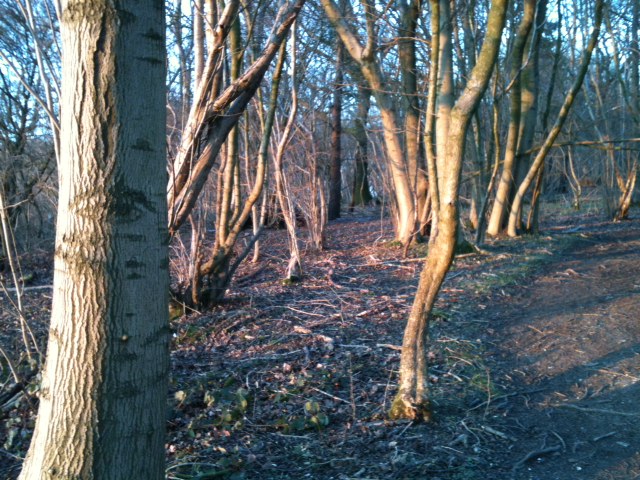
Yet we live a vector. Our experience leads in one temporal direction. As we go along, both consciously and unconsciously we try to make the experience positive for ourselves and, in this direction, if we are lucky, aspects of it become familiar and secure; we achieve a pleasing rhythm and walk easily. Heading backwards does not just interrupt my momentum, it presents a routeway which appears strange. The distances feel different, the vistas are altered, often the markers are no longer clear. Why did I do that? How did it feel – then – on approach? Things look different from the other side.
Metaphorically walking widdershins along my own timeline can feel uncanny, and the uneasiness it generates is fully understandable. Widdershins can, as Burd Ellen discovered, lead us into danger: we do not really go back in time, but may find we’re in a different, disconnected present where elements from the past are now powerful and take us prisoner. We can rewrite our past and therein lies the danger. And the promise.
I make a mistake right at the start, if I assume that the route will be easier because I have travelled it before. It’s so tempting, so natural even, to elevate my knowledge into an abstract, and give myself a god-like perspective, looking down on the route as if on a map I can draw. I forget my knowledge is bound by direction, by circumstance, by singular experience.
So it is better, perhaps, to treat it as an entirely new journey: one to be undertaken carefully; one within which the moments of recognition, when they come, may be disconcerting even as they may be helpful. I can learn new routes and embark on new journeys, so why not circular ones through my past? Fairytales are warnings and also good counsel: for every Burd Ellen, there are many tales of intrepid travellers who, with care and cunning, find their way through thickets and forests, solve riddles and win rewards, and reach destinations from which the future journey is to live happily ever after.
 lesleyjonesberry
A random memory: Many years ago in college, I was invited to a formal dinner by a fellow student who, I realized only years later, had a crush on me. Formal dinners discomfited me at the best of times; like all activities with a ceremonial element, I am holding my breath waiting for something to go wrong, probably me breaking some unfamiliar rule or protocol. This one was made even more uncomfortable by the conversation of the young man who had invited me.
As midnight approached – it was a large gathering, service was slow, and only now was the port being set out – I excused myself from the table and went outside. There was a church adjacent to the dining hall, and as the church bells began to toll midnight, I was gripped by the whim to run widdershins around the church graveyard before the chimes finished. I was, I think, hoping that something miraculous would happen, something of the order of finding myself in a changed world. Of course, I did not. But I did feel that in some way I had unwound the experience of the evening.
All of that because you used the word “widdershins”.
That’s an entire blog in itself (I’d make it one). Running widdershins deliberately to unravel. Church towers often having clocks mean running widdershins also has a sense of time as well as space. What time is it while the clock is striking? It’s one of those events which interrupt, or stretch, or escape the ’petty pace of day to day’ and offer the extraordinary.
Liminal time.
Widdershins made me go back to Song of Enchantment by Walter de la Mare. I must have learnt this at some point as a real song because I can hear parts of it in my head. A very powerful and magical word!