
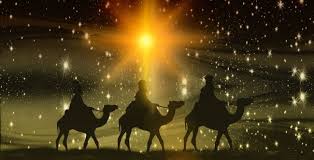
6th January is Epiphany. A major feast day in the Church calendar which has, as soon as we open Wikipedia, a multiplicity of names and associations including Little Christmas and Three Kings Day. It offers, apparently, a choice of things to celebrate. The Visit of the Magi takes the lead in Western Christianity with a wonderfully over-literal suggestion that we need to allow the wise men some travel time, so we spend twelve days waiting for them to arrive at the stable (Or wherever the infant Christ is dwelling: one hopes the census-driven over-crowding has abated and that, picturesque as the stable looks in the paintings, the Holy Family has a more comfortable abode by now). Eastern Christians, on the other hand, celebrate Christ’s baptism at Epiphany, the start of his adult ministry. And the wedding at Cana – the first miracle – also gets a look in. The common theme seems to be the manifestation of the divine to the whole of humanity. Not merely a Jewish messiah, Jesus is shown to be the saviour to all mankind. Epiphany is such a great word and means ‘revelation’ (from the Greek, epiphainein – to reveal). We can all have epiphanies, at any time. Moments of realisation and insight. Epiphany is a blazing, golden word full of positive, energy, immense power. Epiphany sounds like trumpets; it is bright yellow; its mood is overwhelmingly joyous.
Other names are Green Christmas and Twelfth Night and the Christian blurs again with the other rituals and patterns, figures and forms which shape the year for us. With the lack of precision essential to folk traditions, Twelfth Night may fall on Epiphany Eve but, as I have written before, my personal tradition places it on 6th January. It’s the end of Christmas and today is the day to take down the decorations. Christmastide, however we describe it, alongside the feasting, draws us to reflect on the past and turn to face the future. We move through the shortest days, the longest darkest nights and – although we can’t sense it yet – the earth starts to tilt again towards the sun. The Christian festival marks the transformative intervention of incarnation. And, as we count down to the new year, in the secular world the media fills with retrospectives of the previous twelve months and encourages us to step into the new year full of resolution.
I too have been reflecting and resolving, not so much on the past twelve months as on the last two years or so. Our personal chronology rarely fits neatly into the seasonal patterns: some things, unexpected things, bad things, cause us to lose our step in the cyclical dance. Events interrupt and knock us out of kilter. We falter and may fall. We may need longer than a pre-scribed calendar year. Remember 2020 and 2021? I think we all felt it then. The pandemic knocked us all off balance – a collective crisis. We were absorbed by the need simply to cope with each strange and unfamiliar moment. Time itself felt irregular: the days were both brief and endless; there was so much to learn, adapt to and risk-assess, yet intertwined were stretches of empty inactivity. Looking back on it, settling it into a memory timeline, is difficult. Somehow, with things so odd, so unusual, so restrictive, by the time we started 2022 it felt as if we had lived an eternity yet misplaced a year. 2022 and 2023 feel similar to me for personal reasons.
In order to include these ‘out of step’ periods, we want more time than the incessant turning of the globe allows. We need linenfold time, convoluted, coiled, intricate. Trace your finger along the surface of linenfold panelling and your finger travels much further than the length of the panel. Is it extra surface or extra depth? Sometimes we need that extra dimension – a way to allow us more time without using up our lifespan’s length. To live ‘rubato’ – slowing down the tempo, robbing time, so that the notes still get played, the piece progresses but just – please, for a moment – in a way which creates more space to fit everything in and, in the musical context but also in this metaphor, gives room to express our emotions.
It doesn’t, of course, happen. Our internal chronology may flex, shiver and twist. It may cause sleepless nights and lost days, frozen moments that resist being consigned to the past and pockets of lost bewildered hours. But no matter how much we are in thrall to this, we still, in time (ha!) lift our heads to find that the incessant pace of turning globe, of calendar days, of atomic clocks is implacably unaffected. We cannot, as Marvel and Auden (amongst many other great poets) learned, make the sun stand still or stop the clocks. But we discover we may be ready to resume the social, natural, rhythm, re-join the collective dance of humanity and regain a spring in our step.
The tree is taken down. Christmas 2023 has ended and will never be repeated. We turn to the new year: towards another spring, summer, autumn, winter. Another Lent, Easter, Michaelmas, Christmas. Repeating the cycles until the end of the dance. And, today, Epiphany comes blasting through us with energy and light. To clear our eyes, fill our lungs, invigorate our hearts and set us on our way, rejoicing.
 lesleyjonesberry