
Metaphors are ingrained in our language and we cannot communicate fully without them. The word ‘ingrained’ is itself metaphorical. The image is of a piece of wood, and the grain which is part of its very fabric, the comforting associations of something which is natural and organic. I did not write that we are programmed to use metaphor, because that leads our minds towards computing and the mechanistic. I prefer to conjure, instead, a momentary shimmer of associations of wood grain; reaching out to touch the rough, warm texture, or feel the smooth sandpapered, almost soft-to-the-touch surface with fingertips, with the smell of woodshavings and, perhaps, the soothing brushing of oil into the grain to bring out the inherent beauty.
Without metaphors our language would be a shell (metaphor): it would be dry (metaphor); it would be barren (metaphor) and nothing would come of it. We clothe (metaphor) our thoughts in words to create a shape (metaphor) we can use. We walk around the contours of our mind (metaphor), drawing near to a half-glimpsed (metaphor) thought and pulling back from the half-formed. We poke and prod at inchoate feelings to mould, sculpt, forge. To work out how to handle them. This is how we make sense.
This past year my feelings have been overwhelming. They have been powerful and deep and disconnected from easy rationalisation. Sometimes I found myself speechless. “I feel”, I would say, and my hand reached out instinctively to describe a shape. No words. Words did not present themselves. This was hard for one who likes to feel that swimming in words is her natural medium. An essential part of me was upset, bewildered, fragmented. At the worst, not even the hand could reach out, words would not form, and I was rendered entirely inarticulate.
Sometimes I found myself speechless.
Sometimes I could not find myself at all.
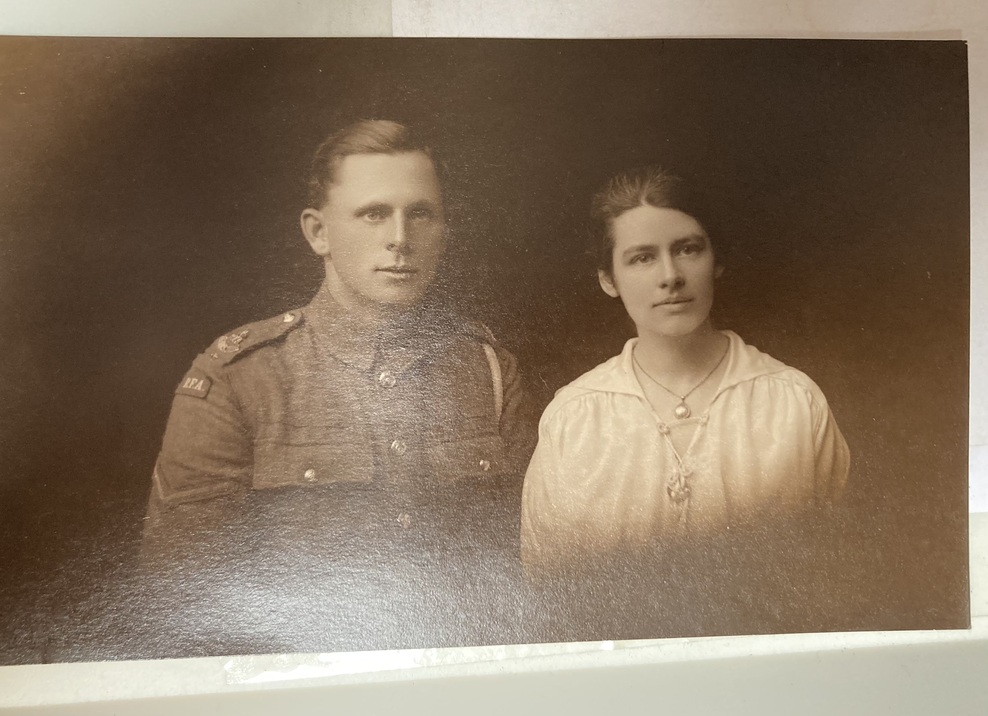
Heart beat by single beat time moves on. Words return, with the metaphoric force coalesced into powerful images. It feels as if they are drawn from my ancestry, although I suspect they are more likely formed from photographs and screens. Nonetheless, I allow and enjoy the illusion of reaching back, far into a generational memory which goes beyond my own. One such is the trench, the First World War trench, surrounded by danger. Safety lies in keeping quiet, head down, being ignored. This vision, this metaphor for how I approach life, is so powerful, it feels beyond mere description or illustration, and I want to link it to my grandfather. Dead long before I was born, he is a mild and gentle-faced man I know only from a few photographs and my mother’s recollections. Married in uniform, young, hesitant, vulnerable. He and his wife showed courage even to take this step of loving commitment – with what hope of a future? How he must have longed to stay safe in the trenches so that he could – oh most human of feelings – survive. So that he might live. And be in the arms of the person he loved.
These images communicate the emotions so clearly but evade rational sense. And perhaps that was necessary, that was the submersive level at which things needed to speak. On one level, the image was completely disconnected from my circumstances; on another it seemed fully resonant. Absurd and yet true at the same time.
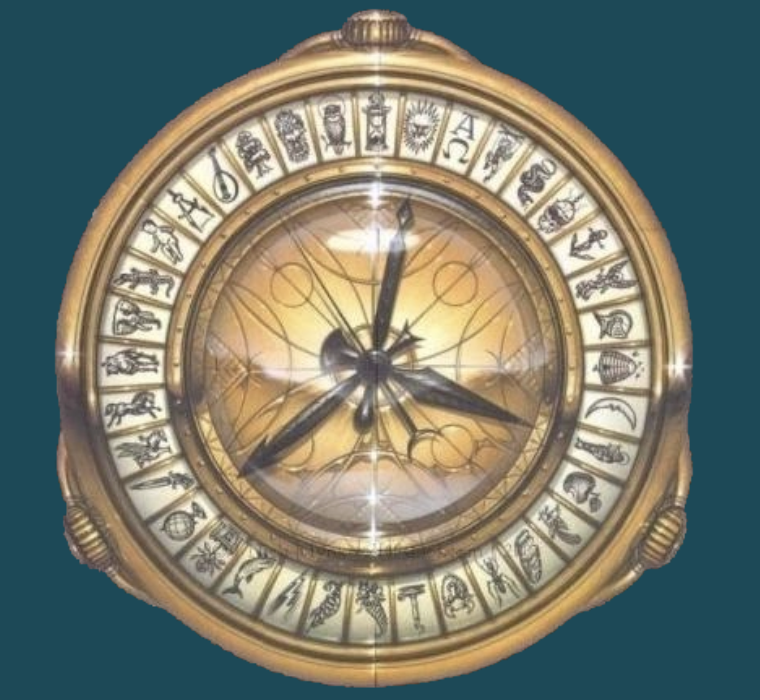
In His Dark Materials, truth is revealed through the Alethiometer, revealed to those, like Lyra, who can focus and cause the needle to spin, and then allow it to settle once, twice, three times. Three, always a magic number and the least number of legs a stool needs to be sturdy – or the number of co-ordinates one needs to fix a location in space. The Alethiometer symbols each have layers of meaning and the more skilled Lyra becomes, the more she can let her consciousness clamber down, rung by rung, and sense the level that matches this time. Then she must synthesise the three symbol-readings together and forge a meaning. This is how you read an Alethiometer.
And so with ourselves: why do I feel anxious? Is it because the train is running late? Is it because my phone is nearly out of battery and may now not last the protracted journey while the need to communicate – to let them know I am running late – increases? Is it because I now anticipate further problems consequential to the delay? Or am I feeling anxious because I am tired? Or because the caffeine in my coffee has made me a little jittery about everything? Or because everything makes me anxious at the moment: I’m stressed in general about something else entirely? Or.. Or.. Or.. the layers go down. There’s rarely just one level of meaning and the best we can do is try to settle on the one we feel matches best just now.
It’s a skill, it’s an art. Lyra, as a child, could do this instinctively but as she grows up and experiences more life the instinctive skill diminishes. She has to relearn the ability, build it back consciously, under instruction, as a craft. Relearn something which was once, which should be, instinctive. Like many things, the important thing is not the perhaps-illusory goal of achieving, but to make a start and stay constant to the orientation. Practise, not practice. It’s more difficult when the context is painful. To re-use the trench metaphor, mine took a direct hit about 18 months ago, so there has been no place of complete safety and the consciousness I am clambering down is fragile and bomb-damaged. This is repair work in a precarious situation. But it can be done.
Yesterday, in Lyme Regis, we read an information board about George Somers. His place in history is complex but one undoubtedly impressive thing which was recorded was this: in July 1609, his vessel Sea Venture was wrecked and the last thing Somers managed to do with the ship was drive her onto the reefs of what is now called Bermuda. All 150 crew and the dog survived. They lived there for 10 months and built – from the wreckage and the new timber available on the island – two new, smaller, boats: the Deliverance and the Patience. Then they were able to move on. Now, that’s good repair work.
‘Salvage‘ after all, saving things from danger especially maritime, has its roots in salvare – the Latin word for ‘to save’. As in, also, salvation. It doesn’t appear to share its roots with ‘salve‘, despite the homophoneity (I may have coined that word). Salvage/salvare are linked to ‘sol’ a PIE root meaning ‘whole’, while salve derives more practically from ‘solpa’ or ‘selp’ meaning fat or butter. Down in the trench of my psyche, I need both. I need salve, balm to ease pain and to help ensure the repair work does not cause more damage. The work itself is salvage and, that lovely building metaphor, it is the task of making good. George Somers built two new boats and then he sailed on.
 lesleyjonesberry