
I left St Paul’s Cathedral at about ten minutes to 8 after a service of Choral Evensong, followed by a mindfulness session and the opportunity to walk the labyrinth installed under the dome: the Chartres design printed on heavy canvas and large enough for perhaps a dozen people at a time to walk on. Each of us journeyed slowly to the centre, rapt in our own impressions and feelings. The dome receded above us towards the heavens; Christ gazed at us, triumphant and golden, above the high altar to the East; the saints and prophets surrounded us with their exhortations to faith. I hadn’t spoken to anyone for over two hours. There were many people there, sharing the experience, and occasionally we’d had to make necessary social acknowledgements: on arrival and leaving, and negotiating a passing point on the labyrinth route. These murmurings weren’t really words or speech and the blanket of silence had absorbed them easily, without disturbing the peace Leaving the building and walking into the gentle summer evening brought a contrast of light and noise – even on this quiet city evening – so, to acclimatise myself back to the outdoor world, I decided to walk a little, along to the next station before I went down to the purgatorial Central Line.

The City of London is saturated with social history: it’s a rich pyschogeographical location (such a useful adjective I only learned the other day). Whether a place is marked with a blue plaque or not, almost everywhere one looks is significant. To walk from St Paul’s to Bank Station, one proceeds down Cheapside. This is an old road, with a medieval name. It’s the market street of the old city, as the side streets called Wood Street and Bread Street attest. About a third of the way down is St Mary Le Bow. The present church is a mixture of 17th century Wren design and 20th century post-war rebuilding; the name refers to the original 11th century church, when its stone arches (bows) were such an innovative and striking feature that they became an identifier. Its legendary bell was heard by Dick Whittington, as he climbed steep Highgate Hill and headed north again in weary defeat, the one that summoned him to ‘turn again’. In 1469 the Common Council ordered that its Great Bell be rung nightly at 9pm as a curfew. You could hear it from as far away as Hackney Marshes, Stratford, even perhaps in West Ham where I live now, and this was the Great Bell of Bow familiar from the nursery rhyme Oranges and Lemons. These are the Bow bells which – if you are born within earshot of them – mean you can call yourself a Londoner, even a cockney.
There is a magic about summer evenings which conjures music. My logical brain tells me that summer evenings see an increase in outdoor activities and open windows and, therefore, there is more music to be heard. I know that. But also it means, for me, the experience of walking in the gentle end-of-day caressing warm air, in a natural benevolence of lingering light evenings which make one feel that the horses of the night have indeed slowed down and time has become expansive. At the limits of my hearing, at the very edges of my perception, I become aware of faint wisps of melody shaping themselves. How can that not be magic? Fairy music, or echoes from another time. Shakespeare has it, of course, in The Tempest (and, by direct quotation, TS Eliot in a section of The Waste Land when it is anchored in London streets):
This music crept by me upon the waters,
Allaying both their fury and my passion
With its sweet air
And like Ferdinand:
thence I have follow’d it,
Or it hath drawn me rather.
It drew me down Cheapside, to the courtyard by St Mary-Le-Bow where a saxophone quartet was playing traditional jazz, in a free concert. It was ending at 8pm: they could play just one more piece and chose In the Mood. This was a little livelier and louder than my mood was ready for, and the square was busy, so I sat and closed my eyes to help listen and focus.
As the music started, the years fell away. Not as far as St Mary-le-Bow could, so easily, take one. Just eighty years or so. Take away One New Change and the other modern concrete blocks of offices and shops. Think about the Firewatchers at St Paul’s who spent their nights guarding the Cathedral during the air raids of the Second World War. And the Cathedral was a first aid post, so injured people from the surrounding streets would have made their way along the ancient route of Cheapside looking, as we always are, for succour and even sanctuary. On the last night of the Blitz, 11th May 1941, a direct hit on St Mary-le-Bow Church caused the interior to burn fiercely and the bells came crashing to the floor. We know, now, that the war was barely a third of the way through, but we also know now that the allies would win. No-one knew either of those things, then: the assault on the church must have felt disastrous, in a war which was so uncertain, total and fearful.
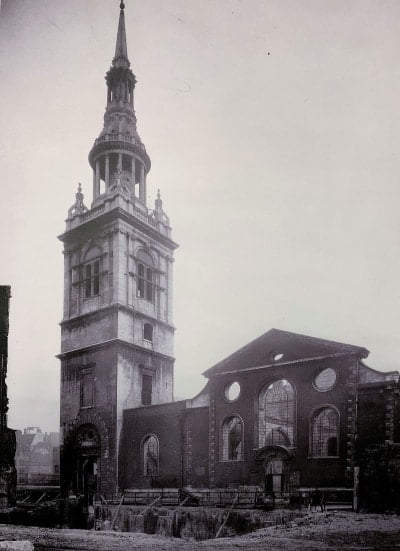
No wonder then, that the strains of Glenn Miller caused time to ripple and summon these – ghosts? memories? to share our present moment and consciousness.
Into my mind came two young WAAFs, balloon girls, who were stationed near New Cross. They manned the barrage balloons to defend the city against enemy bombers. These girls were so young, 17 when they joined up, 22 when the war ended. The world was in crisis, their country was transformed, and they were on the cusp of adulthood. This was formative and memorable and intense.
On their days off, they would come to London, most of all to go to the theatres which stayed open. If an air raid started, the show would be paused and the audience given time to leave to seek shelter if they wished. But most stayed. Some things are worth risking your life for.
One night they started their journey back to the camp and could get no further than London Bridge. A stranger offered them accommodation – able to offer no more than two arm chairs in his sitting room. They were, none the less, wary – a strange man inviting them to his house – but decided, in whispers and giggles between them, that they could, if needed, protect themselves if they kept together. It was a genuine and kind offer, no ulterior motives beyond humanity and social responsibility. The WAAFs slept as best they could on the chairs, returned to the rail station first thing in the morning and crept back into their camp as unobtrusively as possible. I cannot remember if they got into trouble for outstaying their leave. For the WAAF girls, those fresh, lively and delightful figures conjured by Glenn Miller’s music, were of course my mum and her best friend. I am sure they walked up Cheapside at some point, past St Mary-Le-Bow. They certainly listened to and loved Glenn Miller. The orchestra visited London in 1944 and played several concerts, I am nearly sure that one of them, if not both, went to hear him play live. This was their music, this tune, they danced to.
So the music crept by me and the memories swirled around, connecting and comforting and, this feels a slightly odd word, bracing. Whatever I might be feeling now, however bewildering and unique to me it might be, there is great comfort to be drawn from the fact that living always feels and always is bewildering and unique to each of us. Like walking the labyrinth, each of us finding our own individual pathway and full of our own present experience, yet aware that there are others there as well. Being human is, thankfully, a common experience.
The band finished playing, the memories subsided, fading back into the old stonework and melting ‘into air, into thin air’. The normal world picked up its pace and carried on.
 lesleyjonesberry