
Presently (as my son would say), I live alone. The closest I’ve come to this before was as a fledgling undergraduate. Term times in a small self-contained College room, home still a safe refuge. There followed many years of shared domestic environments – house shares, marriage, family life – which expanded, for a short while, into three generations, not to mention cats and dog, then a return to coupledom and now it’s just me.
My best friend is single and, consequently, I’ve been aware that solitary living deprives one of immediate, sociable support, while it also confers liberty and space. Living alone is both a misfortune and a privilege. There is no-one whose tastes, moods and discarded socks need to be accommodated; there is no-one to turn to, to moan with if the washing machine breaks.
Although I have many fears about my new domestic situation, I am pushing them to one side – as yet, the washing machine is functioning, and deeper concerns will have to wait. I’m focusing instead on the gifts it brings, the quietness and lack of pressure. It’s proving quite tricky to accept that being here on my own is enough. My impulse is to involve another, somehow: I want to phone a friend and report any minor pleasure or achievement. This much space seems an unwarranted luxury and I feel I ought to get a lodger. I have to remind myself that I need consider no-one else, neither their needs nor their reaction. My own feelings are valid in themselves and my own response is sufficient. The benevolence offered by the house can be received by me alone. The birdsong in the early dawn, the blooming lavender, the unexpected cat – I experience them. I don’t need to turn to or tell anyone; no-one else ought to be here; it is enough to be just me.
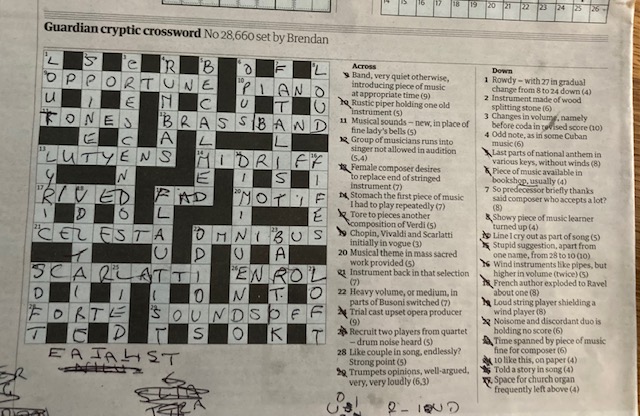
It emerges that I am quite compatible with myself. I like the same TV programmes, but I’m also happy to keep the set switched off and read instead. I’m tolerant of my habit of leaving knitting on the sofa and photographs strewn across the table and, otherwise, I’m pretty tidy. While not particularly interested in cooking exciting meals, I make sure I eat properly. I’d like myself to be a little better at the crossword, but persistence paid off with one triumphantly completed puzzle – eventually. Sometimes I fail to stop myself from pouring a second (or even third) glass or wine, but I don’t criticise myself; nor do I do see any incipient signs of dipsomania. The amount of Radio 3 being played is a little surprising, but I’ve discovered I quite like it. And when I find myself being sad, I give myself a moment and perhaps suggest an early night: things always look better in the morning.
In fact, living with myself is going quite well. This is a relief, not least because the disruptions and radical changes in my life over these past months were destabilising. I felt fragmented, scattered, dispersed. Slowly, however, a sense of identity coalesced and I have found myself again.
When my mum was selling her house, her relationship with long-standing neighbours soured. A small area of land at the bottom of her garden, ownership of which proved unclear, was appropriated in a way which, to my brother and I, seemed objectionable. However, the legal grounds were uncertain and our moral and emotional responses irrelevant. Mum kept her focus – she was moving away and these actions didn’t block the sale; she would not need to look at the changes or even the neighbours. When we protested that this seemed a shabby way for them to treat her, after so many, many years, she simply said ‘they have to live with themselves.’
No matter who else may share our domestic space, we have to live with ourselves: my regained self is not merely my present, it includes my past self. It is a culmination and continuance. I am greatly comforted by a recognition that I feel essentially unchanged from the girl in the College room. Between that self and this woman in the attic there lies a personal history which must be revisited and reinterpreted. I’m starting to recognise strands and patterns; I see changes in myself which I trace to our move to London; and I need to explore further back, which I will do, when I am ready.
Coalesced, I discover, is from the Latin com- “together” + alescere “be nourished.” My ‘coming together again’ has associations not just of unity but also of growth. So, for now, I consider this to be – let’s use Tolkein’s lovely phrase – a house of healing. Alone, I will be both nurse and patient. Living with myself.
 lesleyjonesberry