
At the start of the Zeffirelli film of La Traviata, the overture plays lushly on the soundtrack, while Violetta drifts through deserted rooms like Miss Havisham. At least she does in my head – I haven’t watched the film for over thirty years. She is waiting for her lover, and she is waiting for her death: this being full blown Romantic opera, both come, the second hard on the heels of the first, just allowing for some impassioned heart-rending, full-lung-capacity singing to stretch – nay blow apart any pretence at – verisimilitude.
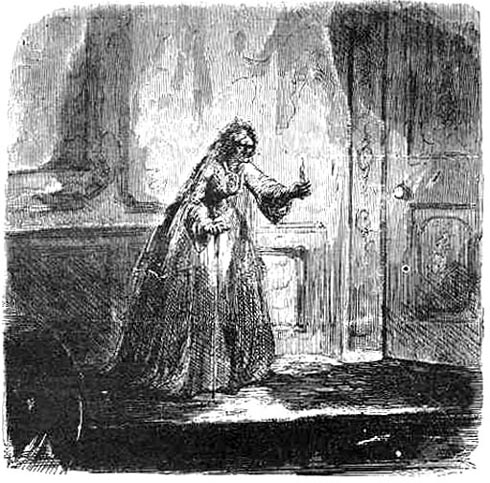 I have my Violetta/Miss Havisham moment most evenings – the drifting, I mean. Not the singing, nor the lover nor – as yet – the death. Switching off the TV at the end of the evening, I find myself ‘putting the day to bed’ and setting up for the morning. I progress from room to silent room: taking a mug back to the kitchen, fetching a glass of water; preparing my bag for the morning, tidying away a garment, a book, a newspaper. The house is oddly multi-levelled, so the journey is all steps. Down to the kitchen, back up to the hall, up to the half-landing and bathroom, turn and up again to the bedroom, further up to the attic if an item needs returning there. At some point I think ‘I won’t be able to do this when I am older, think of my knees’ and at the same time I become aware, once again, that I am very fond of this house. So many corners, levels, different perspectives from each turning, feeling like a rich use of the space. It sits inconspicuously within the modest, traditional terrace, each small house supported by, bounded by, and propping up the others; yet within is such a strong sense of individual identity and small moments of delight. It doesn’t promise to be anything it is not, and just quietly, undemonstratively, exceeds expectations. I realise again that it is a house I want to live in. It is a way I want to live.
My Miss Havisham persona is unexpected. This was the chosen house, the restoration of stability. Moving here was meant to mark the end of the strange displacement and division of house, and dwelling, and dispersed possessions. And of the strange psychological darkness with which I’d somehow imbued my recent past. This was chosen as the place we could, once again, call home – and become a new family home, incorporating the increased assurance and joy gained from these London years as a couple.
I have written before about the occasions we know are significant at the time, and the ones which only become significant with hindsight. There have already been many, too many overtly, blatantly significant occasions in this house. We’ve burdened it with an intensity of emotion which felt out of character.
And yet perhaps the house was exerting its influence: it was bought as the place where everything could be brought together again and perhaps this is a house which refuses to keep secrets. Even the attic is an open space. There are corners and turnings and nooks; there are many spaces to be private and places to put things down and leave them undisturbed: the family photographs, the old toys, yes even the boxes just marked ‘nostalgia’. But things are not hidden and there is no room for deceit. Alongside the Lego and the books and the Christmas decorations, we brought with us the ‘boxes of crap’. And, as it turns out, we really were living a metaphor. There was much which came with us unsorted, undealt with, unquiet, unknown. And in this house, we’ve opened the boxes.
I wander from room to room, to say goodnight to this honest house. I had not expected to be here alone, that’s all. So the house is bigger than I need, much as I revel in my role of custodian of the family history, and probably bigger than I can afford. But that’s yet to come clear, just as I do not yet know if my Miss Havisham drifting will become significant: we take many new steps and only later do we realise that we have, through repetition and persistence, re-orientated towards a new destination. At the end of the day, my dad would always set the dishes for breakfast and open the living room curtains before he went to bed. Perhaps I am turning into my dad. For me it is, somehow, tending to the house, preparing it, as well as myself, for bed. Walking a benediction at the day’s end.
And in the morning I wake in this gentle house. Sunshine floods through the attic skylight. The objects I love and the memories they contain surround me. A morning text from my best friend assures me the people I love are still out there. And there is, usually, work to be done. So I wash, and dress, and ready myself, open the front door and close it behind me. It’s a new day. The house, I trust, will await my return.
 lesleyjonesberry
Pingback: Hacked off | lesleyjonesberry