
‘Our possessions outlast us, surviving shocks that we cannot; we have to live up to them, as they will be our witnesses when we are gone. In this room are the goods of people who no longer use them’
Hilary Mantel, The Mirror and the Light pp66-67
I like change, but I approach it crabwise and incrementally. I sidle up, try to consider it from all angles. I review and rehearse each step, until that one feels comfortable, and I can look towards the next. I am easily alarmed, and superstitious, and like time to adjust. Since March, however, the pace has been disconcerting, the big conceptual shifts overlaid with urgent practical tasks.
After four years’ in London we are selling the house in Hampshire and buying here. There was a long lead-in time on this – first reaching that decision and then, because we had tenants, giving them time to move. In March the tenants moved out, we resumed possession, put the house on the market and, since we’d left stuff packed in the garage and attic, had to work out what to do with it. To be honest, we had to remind ourselves what we’d left there.
Being reunited with objects put aside four years ago stirred up a range of emotions: pleasure, surprise, guilt, confusion, nostalgia. There was, inevitably, more than we had remembered. Self-evidently, what we left behind was not essential. So, after four years without any of this, why are we keeping it? Some objects engender confusion, especially – for me – pieces of old furniture which belonged to my parents and, before them, grandparents or great-aunts. I do not know if they are kept out of love, thrift, duty…probably a combination of all three. We don’t have room for them in the flat and, to be honest, I don’t particularly want some of them. But can I get rid of them?
An offer on the house came unexpectedly quickly. We stood in the garage, just days after the tenants’ departure, surrounded by boxes and stacked furniture and chaotic memories, and the estate agent ‘phoned. Would we accept? We did, moving everything that we’d left behind into storage in London. It’s all overburdened with symbolism – I want to say we are living a metaphor but I am not sure that’s possible. Perhaps it’s an occasion for that over-used intensifier ‘literally’. We have literally distanced ourselves again from the house, leaving it blank and empty and ready to hand on. But all our baggage, everything we left behind at the move, is now in London and it will cost us to keep it, until we deal with it properly.
I do not understand why I find this so difficult, so difficult that this blog was started in March and I didn’t return to it until May. I’ve written already about the pleasure of using objects which have been handed down to us, the cherry-picked items which bring joy each time they are touched. But, conversely, other items are burdensome. We don’t particularly want them but don’t feel free to dispose of them. ‘This belonged to your grandad.’ ‘Your mum loved this.’ ‘Your dad made this.’ Well-meant phrases, that swirl miasma-like around totemic objects, wisps of ectoplasm reaching out to pluck at our sleeves, our hands, our hearts. We should make no demands after death, place no conditions on our bequests: those we love should be free to choose how and when and if to summon our ghosts. But of course that’s impossible; we can’t confer such liberty even if we try.
Discussing this with our children only adds to the confusion: the objects I feel least inclined to keep for myself are inevitably the ones they mention that they would like, at some point, in the future if they have room. Of course they are. None of this can be careless; it’s all sodden with significance. These things are tangible links to their past as well.
And we are selling the house the children lived in; we are selling the house we all shared. It feels as if we are, again, making them homeless, despite the fact that they are adults and despite the fact that wherever we live, our dwelling will always be their refuge – the place they can flee back to. The potential for guilt extends both ways, past and future, forward and back, guilt because of love, ay there’s the rub, and we don’t want to lose the love. All together, all mixed up, difficult to sort, like one of the boxes we packed for transit, labelled literally ‘drawerful of crap’.
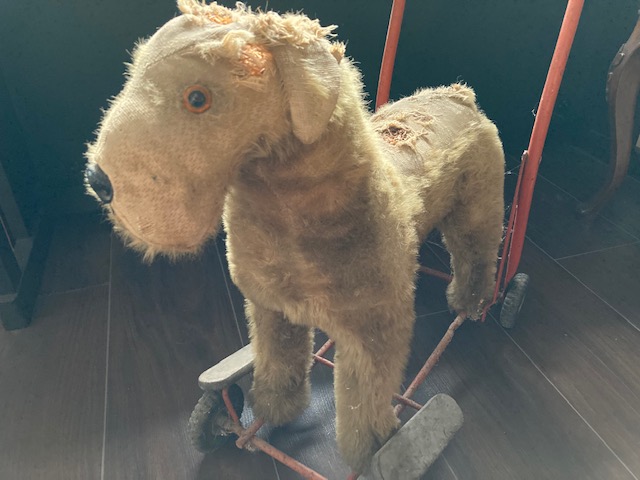
It was March and now it’s May. So the sediment of feelings has re-settled. In these clearer emotional waters, we are looking for a new house, smaller of course (moving to London makes downsizing not so much a life-style choice as financial necessity) but we will fit in what we can. Some stuff will have to go and the decisions will, as ever, be a strange mixture of practical and ludicrous – there is absolutely no reason to keep a damp-stained, rusty old steamer trunk or George, a bald, fabric-rotten dog walker, but somehow we will. And if we can do that, then surely we can find room for the grandfather clock and the bureau as well, if that’s what the children want. After all, what are attics for?
Houses are metaphors too. You don’t want them too tidy, too empty and bare. You need functional space to cope with the day-to-day, a place to rest, enough room to breathe freely. But it does no harm to have a bit of compromise and muddle, emotional baggage. Things for the future, things from the past, things we haven’t quite got round to dealing with, but maybe we will, one day.
 lesleyjonesberry