
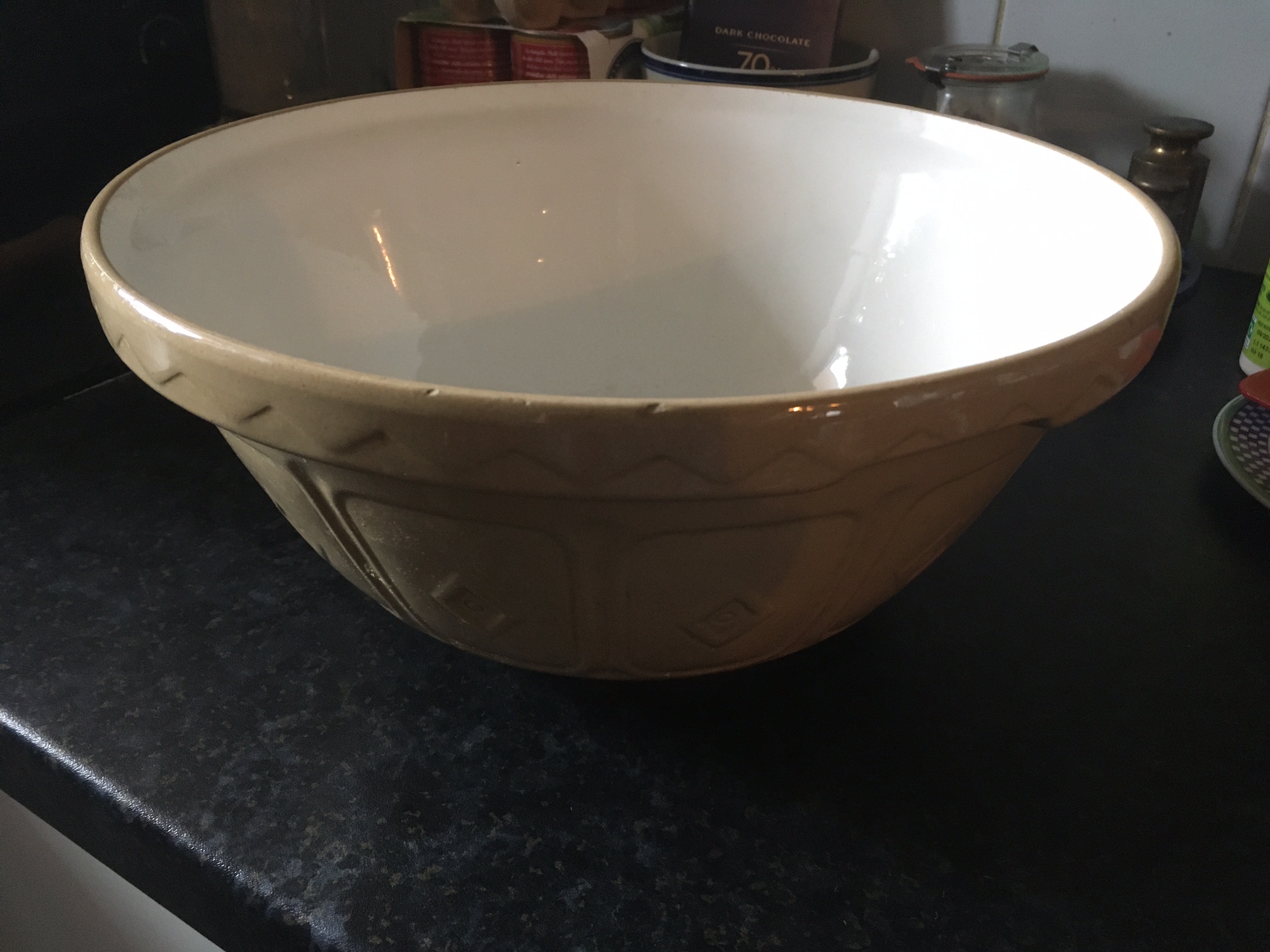
 I made a cake at the weekend. I don’t often bake these days but it was my son’s birthday and traditions are reassuring. My mixing bowl is a Mason Cash – you know the type, surely in the UK it is the ur-mixing bowl of mixing bowls.
This bowl was my mother’s. I can’t remember how or when it came to her; in my memories is was always there. This was a time, and social stratum, when newly bought items were rare, and inherited ones more common. So it may be that the bowl first belonged to her mother or aunt.
Also characteristic of the era, and our income, my mum was a habitual baker. Home-made cakes were cheaper than shop-bought; pastry allows you to stretch a moderate amount of meat into a pie; if all you have is a sack of potatoes, then making them into potato cakes metamorphoses them into a treat. Increasing the carbohydrate in a meal keeps the family feeling well-fed.
 So the cane-coloured mixing bowl was a frequent sight, and stirs some of my earliest memories. These are clichés of a ‘poor but happy’ childhood: sitting close by, waiting to scrape out the bowl as soon as the cake goes into the oven, or working on a piece of spare pastry, with my incompetently washed hands, until it was grey. My dad, who was a woodwork teacher, made me a small rolling pin. I have that, too.
In my unreliable memory, this is when mum talked about her own, pre-war childhood. Her early adulthood was full of event and difficulties – a country at war, and personal loss. A happy childhood, Mum said, was something that no-one could ever take from you, whatever happened.
Time creeps past us unnoticed, so that we express repeated, but always new, astonishment. How can my son be 28? The years are plainly seen in his transformation, and on my own face, but the mixing bowl exists in a different time frame. It appears unchanged. 28 years or 50 years, these are nothing to a piece of ceramic. The baker ages, the baker is replaced, the bowl remains.
The change is in our own perception. I imagine my hands and my mother’s superimposed, touching once more. Perhaps others’ hands too, stretching further back, and forwards: I hope to pass this bowl on to the next generation, among my confusion of goods and chattels. Of course, they may not want to keep it, or it may get broken. Ceramic is durable, but fragile and the accidental nature of all this is part of the charm.
 In Philip Pullman’s His Dark Materials, the ‘shadow particles’, Lyra’s ‘dust’, gather round ‘anything… associated with human workmanship and human thought’. I like to think this might apply to objects we pass on, how with each usage, with each mundane, nurturing act of preparing food, the bowl itself is imbued with another tiny layer of.. of common humanity, of the familiar, even the consciousness of happy childhood, of loving and being loved.
In the meantime, and in memory of the way this bowl has been used so often before, I make a cake for my child’s birthday.
*The Subtle Knife, Chapter, ch4, p93 in the 1997 Scholastic paperback edition
 lesleyjonesberry