
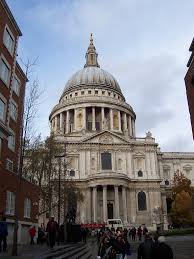
 On Good Friday we went to St Paul’s Cathedral for Matins. It’s a formal choral service, dominated by sung psalms, anthems and responses, creating a context for the congregation to dwell in the music, the mood, the building. For me, it creates a restorative and peaceful space: I breathe a little more slowly, more deeply, most restfully.
I often feel better after going to church, but I don’t go very often. In my teens and early twenties I was a Christian, involved with my local church and my school, later my college, Christian societies. Overlapping with this, I sang in choirs, at school, church, college and since then, although less regularly, in choral societies and community choirs. The singing has lapsed at various times and I know this to be through lack of time and pressure of other interests; the matter of religion just seems to have lapsed. Gradually, progressively, a little regretfully, belief became less focused, less important, less plausible, until I admit to being faithless.
It feels sad and faintly disturbing to write in this way, in part because I know some of the people who take the trouble to read this blog. They read it because they are close to me, and they are very dear to me and I worry about their response. Nonetheless, that’s where I am. Occasionally I try to identify specific factors or decision points, but most of all I feel I’m merely a classic indicator of a change in English society. We have become predominantly secular, and Christianity is an increasingly marginalised and minority element. While on a personal level, the best I can manage is that I like the idea of God, but it just feels like wistful thinking.
So why go to St Paul’s on Good Friday? Partly it is the music. I don’t need to go on about the benefits of singing for individuals and even more for communities. Gareth Malone does that far better than I. And I have participated in enough formal choral singing, and listened to enough classical music, to love and appreciate the English choral tradition. Also, I listen to a good organist with very great and nostalgic pleasure: for a short time I was also a church organist. That was at a very basic, parish level, but doing something at any level is one of the best ways to learn better how to appreciate it at the highest. Yes, one can go to choral concerts and organ recitals, but this takes the music away from the context it is created for. It just is better, it functions better, within a service.
And then the liturgy. Words which have been considered and debated and adapted through centuries, trying to do the impossible: trying to communicate the ineffable. Trying to translate complex theological concepts into a shape which allows everyone, anyone, to participate in an act of worship. It’s impossible, of course. But this brave, heartfelt attempt has continued, continues. Words are changed and phrases adapted, and sometimes they are clunky, and sometimes facile, and sometimes incomprehensible. However flawed and falling short each attempt is, the very repetition and connexion throughout the revisions makes it meaningful. There are many parts of the liturgy where I could stand next to my grandmother, next to my great-great-grandmother, and further back, and we would all recognise the service, we would all be able to share in the same moment. So, paradoxically, however much it falls short in relation to its ultimate aim, something has been created which escapes the bounds of time and space.
The picture which comes to mind is of a web, a net. The service offers me a space and duration and experience that, a little ungainly, I clamber into, and lean back: I let go for a little while, and it lifts me. I become part of something a little larger and more collective. It’s possible to relax my hold on the incessant demands of individual consciousness, contemplate other patterns, through language and music, and participate in something greater than myself.
Of course, the more I write, the more that I feel I may be expressing a sense of what worship is about. But my participation is merely sublunary, mundane; I don’t find this experience leads me any more towards what I might describe as ‘the divine’. So, as someone who started by declaring a lack of faith, am I being parasitical by attending in this way? The phrase that recurs is the title of the blog – I no longer attend church to pray, but – in TS Eliot’s luminous words – to kneel Where prayer has been valid. TS Eliot became a man of deep Christian faith; for him I think kneeling where prayer has been valid was a starting point towards a profound, delicate and difficult experience of faith; for me it is, for now, the end, not the beginning. But – to use another of my favourite recurring words – perhaps, at times, that is enough, still.
 lesleyjonesberry