
A few days ago it was announced that John Burningham has died. He wrote and illustrated children’s books and was the illustrator of Chitty-Chitty-Bang-Bang, the book by Ian Fleming which became even more famous in a musical film version. As is often the case when a figure who featured in my own childhood dies, my emotions were mixed: for all there is sadness at the individual’s passing, there is also a selfish surprise that ‘all this time’ someone with a symbolic role in my life has been continuing with theirs, a faintly bizarre altruistic satisfaction if, from the obituary, it seems that they had a good life (as it appears did John Burningham), and the poignant pleasure of early memories resurfacing. The public statement prompts sharp, personal and vivid fragments of recollection.
The memories are of my mother reading to us books which we borrowed from our local library. I have already identified that climbing the stairs, to the upstairs room in the little end of terrace house which was Blackrod library in the 1960s, is probably my earliest memory. My mum would take me and my brother there regularly and before we could read ourselves she would read to us, every night at bedtime and often during the day as well. I think this was pre-school and it is possible that it coincided with my dad being away during the week, doing the teacher training course which moved him from the joinery trade to a profession as a woodwork teacher at secondary school. So mum had two small children on her hands and lots of time to fill. She once got in trouble at the library for returning books on the same day that we had borrowed them – the (entirely manual) system of book slips tucked inside library tickets, which had to be sorted and filed at the end of each day, wasn’t set up for such a fast turnaround!
At some stage, mum developed a cold and was losing her voice. So she was concerned that she wouldn’t be able to read to us at night and made a recording for us, on a big reel-to-reel tape recorder. I think the box was green on the outside, cream inside, with big buttons to control the huge brown reels of tape.  Onto this unwieldy but strangely fragile system, mum’s slightly husky, phlegm-thickened tones were stored. What she read was a slightly odd storybook and nearly fifty years later I was convinced it was somehow about a goose, something about a sweater, a voyage, and the word Borka.
The wonders of the internet. All the damage it does, the dangers it contains. But also, magically, it verifies these half-remembered fragments and reunited me with them. For Borka, the Adventures of a Goose with No Feathers was John Burningham’s first book, published in 1963. He won the 1963 Kate Greenaway Medal from the Library Association for it and, at the 50th Anniversary  of that award, a panel of experts placed it amongst the top ten winning works. It remains in print and so, in my 50s, I finally bought a copy – having never owned it before, of course. The childhood one had to go back to the library. I read again about Borka, an ugly duckling who remains an ugly duckling: she is a goose who has no feathers, and so cannot fly with her family. But she has a loving mother who does what she can, and then Borka has adventures of her own, and finds a safe home.
I don’t know, of course, how much of what I write is true. I don’t really remember this. I think my memory of the library stairs is real. But recording the story of Borka… most of that I know because mum remembered it and told us about it as well. It wasn’t a major incident in our past but it was one which was recalled occasionally: so we built this family story together and reinforced it, until the tale overlays the actuality and it is impossible to discern which is which. But that doesn’t really matter – the power is, as it always is, in the narrative. Not just the event itself, it’s the accrued shape and significance that matter.
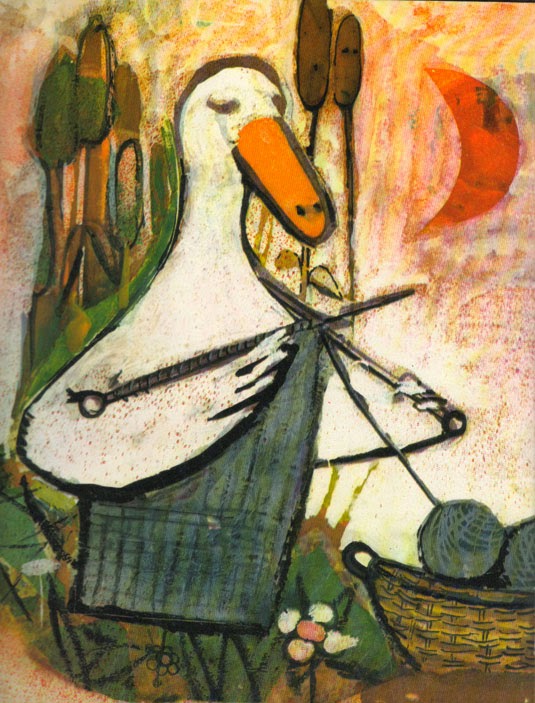 Until writing this, I hadn’t realised how recursive this story was, that’s it’s all about maternal love. My mum was born in the 1920s. When she signed up to join the WAAF in the second world war, she journeyed away from her family home for the first time to face unknown dangers both personally and nationally: she knew acutely that a loving childhood home was a great blessing and strength, and she also knew that it could only be limited preparation for whatever uncontrollable challenges life might bring. She did her best to provide a safe, secure start for me and my brother, telling us that, whatever happened, a happy childhood could never be taken away from us. Now, in turn, my own children have started out on their adult lives. I don’t know if what I have done is enough; I don’t know what their lives will bring; I can’t fix their problems for them because these are bigger, now, than lost school books or broken toys or bashed knees.
Perhaps it wasn’t an accident that Borka was the library book my mum wanted to share with us, even if she couldn’t be there to read it herself. In the story,  Borka has no feathers and her mum can’t fix that. But she could knit a sweater to keep her gosling warm. Then, when the family had to leave and she was on her own, Borka was able to go on to have her own adventures, still wearing her sweater. Borka’s mum couldn’t fix things or keep Borka close for ever, but what she could do, maybe it was enough.
 lesleyjonesberry
Two hands clapping