
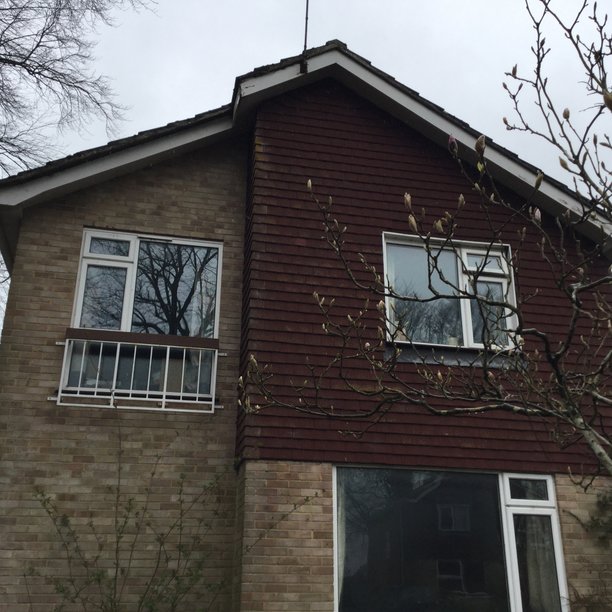
 Like many of their generation, my parents grew up in rented homes and were first-time property owners. My grandfather viewed my father’s ambition to buy his own house with suspicion. They were savers, not spenders, and debt, in the form of a mortgage, was a grave concern. For my father, however, property owning meant security and independence.
It also meant responsibility. He bought an old house, set on a wet windswept hilltop. I remember, as a child, being woken at night by the wind rattling the sash frames and howling in the chimney. I would get out of bed, stand at my window, watch how the streetlamps illuminated the rain which pelted onto the glistening black tarmac of the road outside. Listening to the wind, I looked at the damp spots on the wallpaper and, although home was a place of safety, it also felt like a burden as my parents worried about how they might afford necessary maintenance and desired improvements. Inevitably, perhaps, I took these attitudes with me into adulthood.
My husband and I moved into our family home on my birthday in 2002. We sought stability and continuity after years of living in rented military quarters. Most importantly, this meant the children could forge relationships outside the family, at school and in the community, and expect these to continue: neither they, nor their friends, were likely to be moved on within months, as had been the pattern. We also rejoiced that we could paint the walls any colour we liked and hang as many pictures as we wanted. No longer dictated by the MOD’s schedule, building works and redecoration could be undertaken – or not – as we chose.
We invited my now-widowed mother to join us, to move from the hilltop house. Conscious that this was a big step for her, we pooled our household possessions. Crockery and furniture, books and bedding, we tried to combine as much as possible so that everyone might feel equally at home. Of course, there was too much, but if in doubt we tended to say ‘let’s try to find room for it somewhere’.
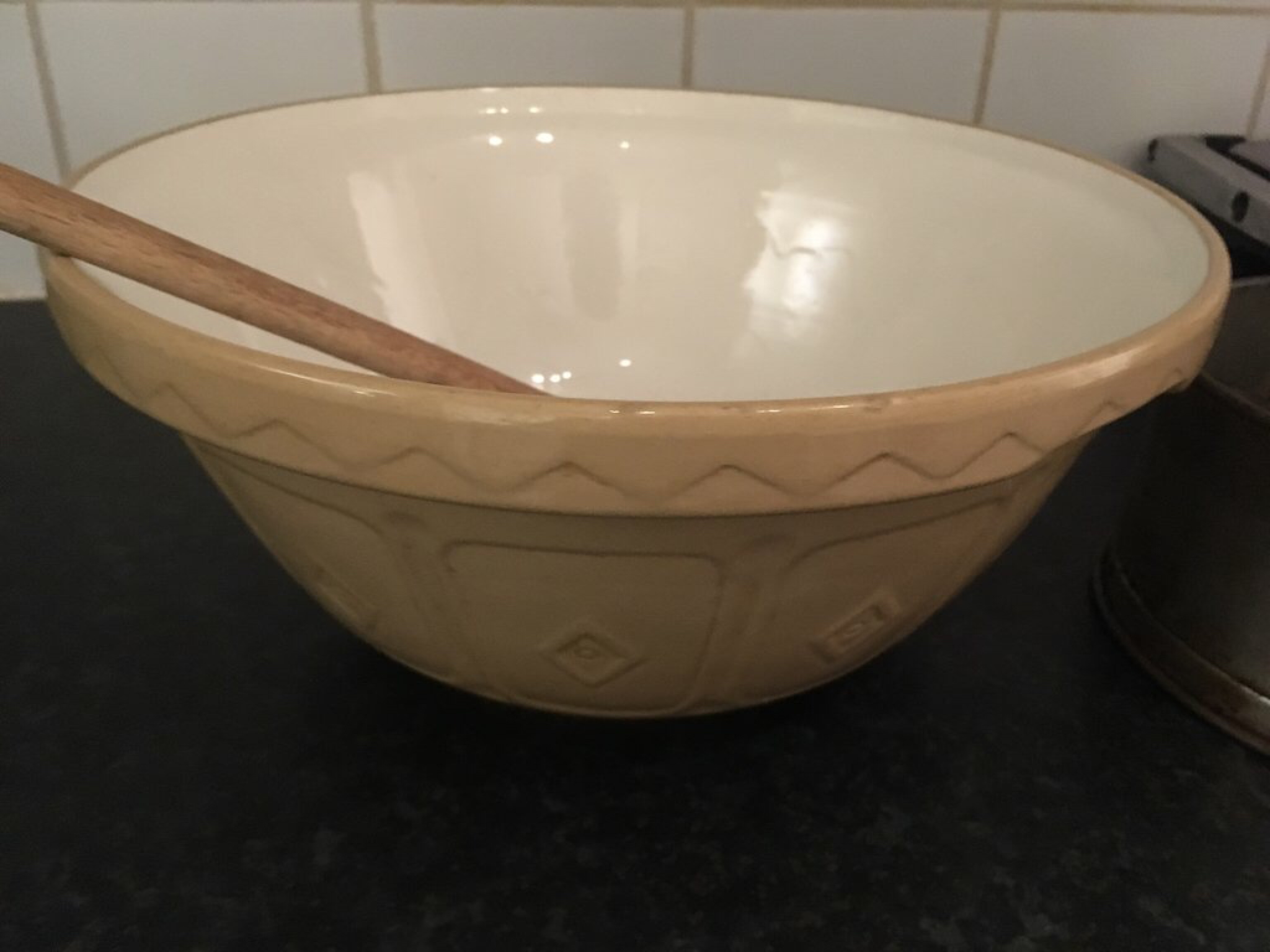 Much of this was lovely for me: it brought into daily use items which I remembered from years ago; our new house was immediately rooted in, connected to my past. When we made a cake, we used the mixing bowl which my mother had received as a wedding present, stirred with a wooden spoon I had bought as a student, and baked in tins inherited from my grandmother.
But also, from the start, we had more stuff than we had space for. There were rocking chairs in the garage and boxes of old games and glassware in the attic. Then my husband lived away from home for a while due to work. He returned with more things – ornaments, kitchen 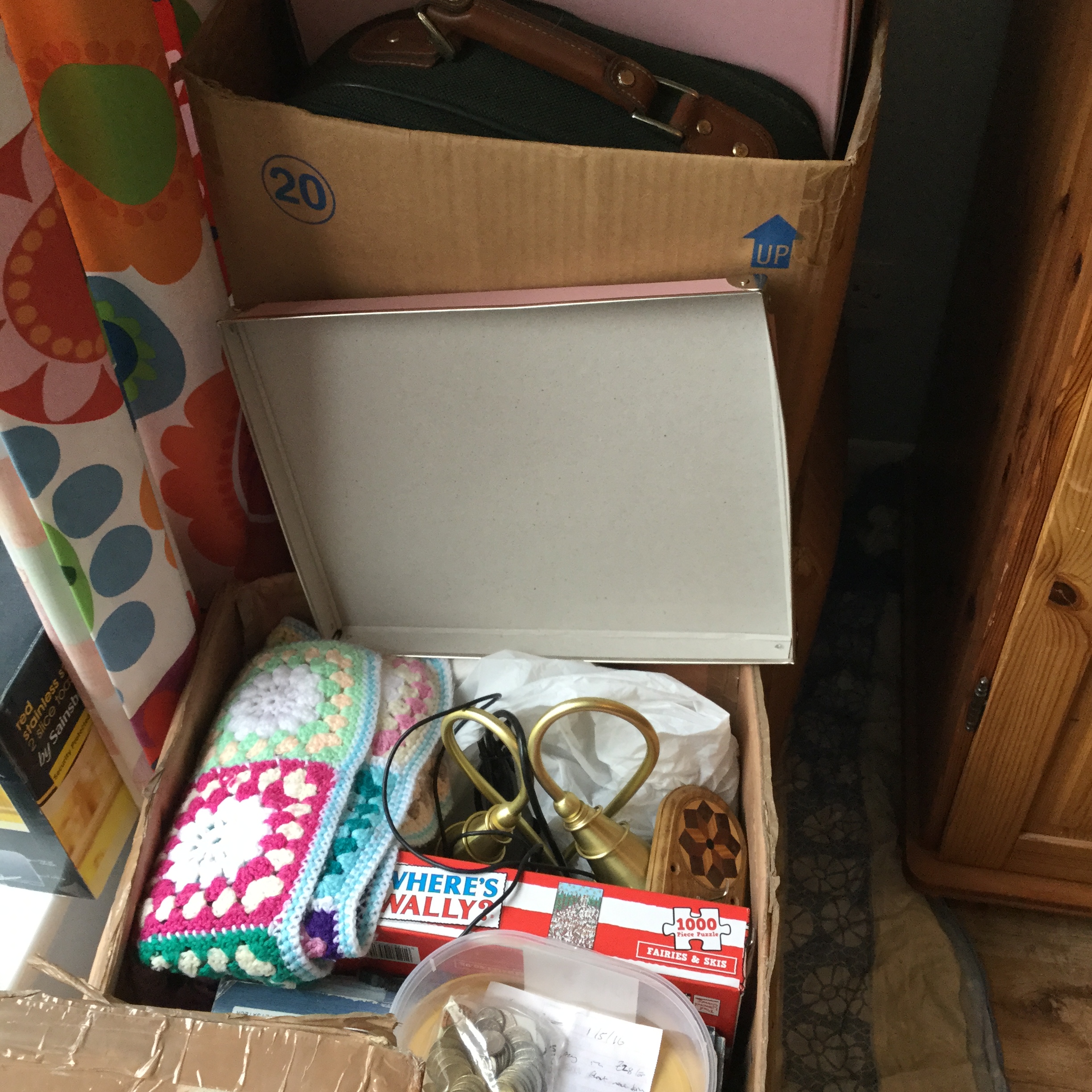 equipment, paperwork, bits and pieces – to be stowed, pending sorting, absorption, disposal. My mother-in-law died and we inherited more evocative, nostalgic items, links to my husband’s past and family. Meanwhile, my mother’s health declined. It would have been cruel to ask her to make decisions about disposing of things she had brought with her, even if they were now evidently superfluous. And even harder to take the decisions without her. So we just stowed more in the garage and more in the attic.
We don’t, on the whole, confront things in our family. Our instinct is not to challenge, not to go for radical upheaval: we try to adapt, to allow time to consider, to be patient. As we all know, however, some things just don’t go away: a policy of continuous accommodation reduces the room to manoeuvre, not just physically but also emotionally. So much of what we had in the house was about the past and was being kept for the sake of others. As the years went on, the house felt, increasingly, like a responsibility which I was failing to live up to. It was, in the words of the General Confession, full of things left undone which I ought to have done: sweeping leaves, weeding flower beds, cleaning window sills, but most of all, it was full of stuff: however much it was valued, it was also, to be honest, stultifying. And as the household went down from five, to four, to three, to two, it felt as if we were maintaining a base which was merely somewhere to return to. Events – excitement – life – took place elsewhere.
So we moved. As I have written about already, we tackled much of the stuff (not all – there are still boxes in storage!), and, crucially, we worked hard not to over-fill the flat we live in now. We hope there is enough for our children still to feel they are in a familiar place. We have discovered new-old things: soup spoons and coffee cups which had been packed away, now in frequent use. And the wooden spoon, the mixing bowl, the baking tin. They have made the journey.
Moving out from our house has been a great, a strange relief. This is odd, since moving in 14 years previously was also a huge relief. At that stage, we craved assurance that no-one would move us on; to be able to look ahead and see that nothing need change was exactly what we needed. This time we needed to know we could move away, that we could look ahead. We needed the possibility of change. The flat we live in now is much smaller than our house, but we don’t feel constrained. In fact, when we arrived, we felt freer. And being a flat, there is no attic and no garage. So it’s harder to hide things away.
 lesleyjonesberry