
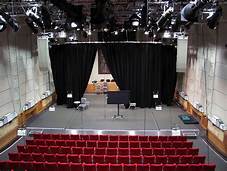
 The other day I received last-minute tickets for a BBC recording at the Radio Theatre at Broadcasting House. I had no other plans so decided to go, despite the short notice. I also realised that what appealed to me was multi-layered: not just the show itself (Newsjack), but the more general enjoyment of watching a live recording; not just the event, but the fact that the ticketing/admission process involves waiting beforehand for about an hour.
And there I checked myself slightly.
The waiting around for an hour beforehand?
But it was true. The ticketing system at the BBC means that you need to arrive in good time to be sure of admission: to ensure a full house, more tickets are allocated than they have capacity for. On the night itself, from about an hour and a half before the recording starts, tickets are validated, in order of arrival, and this guarantees entry. Once your ticket is validated, you are free to go away again, but most of the audience choose to come into the warmth, get through the security checks and wait inside. There is a bar with snacks and sandwiches, there is a shop, you are welcome to bring your own food, there are chairs and tables. I have now spent several happy hours there, with my supermarket salad, a glass of wine, a book. It wasn’t, however, until I went there on my own (I usually go with my husband) that I realised how much I enjoyed this part of the evening.
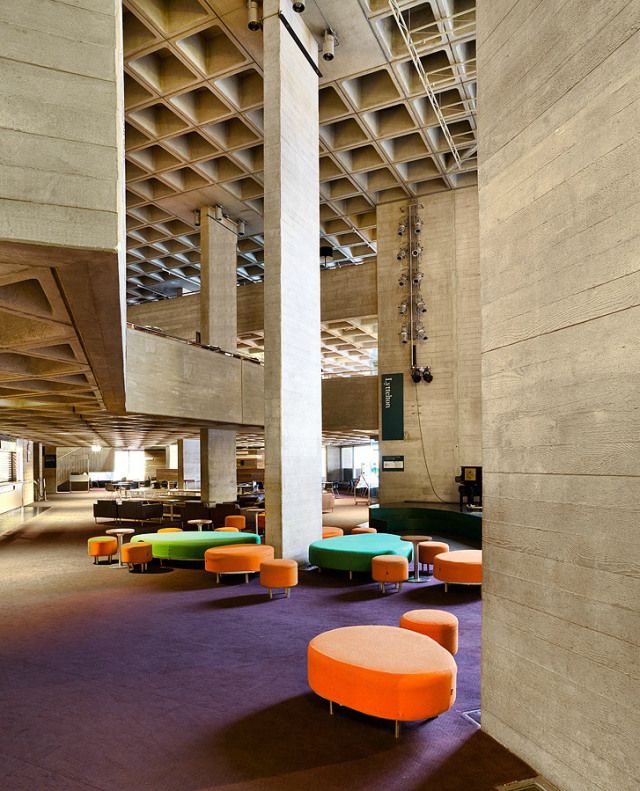
The space reminds me of a theatre foyer. Not the cramped chaos of many West End theatres, but the modern foyers in modern regional theatres, at the National, at the Globe. They are open all day and people come to browse in the bookshop, buy tickets, drink coffee, have informal meetings. The pace is leisurely but not idle. People are passing through, but feel sufficiently welcome to stay for a while.
I like interim spaces, liminal spaces. To the side, on the edge, the prelude to the main event. In domestic interiors, I like landings and corridors – although corridors always carry a frisson of danger and pursuit; there may be something nasty approaching round the corner. Modern houses are designed to maximise room area, so these crossing points are minimised and reduced to the merely functional, whereas I rather like odd corners, spaces with ambiguity. Theatre foyers, of course, only exist because of the promise of something more definite, more exciting: the performance space itself. Their purpose is entirely relative.
One reason I like these areas in public buildings is the lack of pressure. If you are waiting for the performance to begin, then you have already completed your ‘part of the bargain’ – you have arrived, you are ready to take your place as a member of the audience. Someone else will now take control and tell you when to go forward and take your seat. There is nothing else to do. This interim time is without direction or pressure. And this is, to me, a great luxury.
These are sociable, shared spaces. It’s impossible not to overhear snatches of conversation and I love to people-watch. The dynamics between different groups of people fascinate me: the eager, the insecure. Occasionally there may be arguments but most often there is laughter, good humour and helpfulness. My favourites are the comfortable couples where long-standing familiarity has developed into companionable sharing of tasks, sandwiches, crossword clues. For a short while, our human needs appear both to be very simple and to be fulfilled.
These are the in-between areas, characterised by entrances and exits, on the way to somewhere else. Like CS Lewis’ Wood between the Worlds, they are places to pass through. But like Polly in The Magician’s Nephew, I find myself very content to stop there. Lewis seemed to think the languorous pleasures of the Wood between the Worlds might be dangerous. Polly has to be recalled to herself: she has a task to complete. Sloth is, after all, a sin. But TS Eliot writes persuasively about the significance of still points in turning worlds, the attraction of places and states which are neither one thing nor the other. These can be precious moments of suspension, amongst others but without focus or demands. Their transience is part of the pleasure. To dwell in the moment, before the bell rings, the doors open, and it is time to move on.
 lesleyjonesberry