
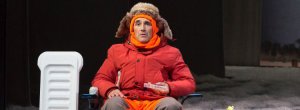
 On Friday evening I went to see Nice Fish. A whimsical, delicate piece developed by Mark Rylance in collaboration with Louis Jenkins and based upon the latter’s prose poems. In addition to the sheer joy of seeing Mark Rylance on stage – no-one else is quite so relaxed, so playful, endearing, gracious – the piece offers a meandering meditation on living (it’s irresistible to compare it with Waiting for Godot). And on Sunday morning I went to Shakespeare’s Globe with a view to being a volunteer steward this summer.
These are the kinds of things I hoped to do by moving to London, although the developments in international and domestic politics make me wonder if this is ‘fiddling while Rome burns’. There is, of course, a strong tradition of rallying calls that the arts are never more important than in times of crisis, of art as a vehicle for protest. But do I actually believe this? What does an hour and a half watching Mark Rylance dressed in a bright orange puffed jacket, clowning and making snow angels on stage, actually give me, apart from pleasure?
One answer, perhaps the most important one at the moment, is empathy.  Watching a well-written, well-performed play, we are imaginatively drawn into the world presented to us and we gain insight into what it might feel like. What it might be like to be a Midwestern fisherman in Missouri, or a king on the eve of battle, or a member of a family realising that their actions may have contributed to a young person’s death. Each
  and every time, we see that things are always, always, a bit more complicated than that*.
Drama makes it more difficult to separate us and them. Once you have shared the experience with a character on stage it is harder to be simplistic, harder to revere, much harder to condemn. The same thing happens in fiction – it’s an imaginative gateway into seeing the world through others’ eyes. It’s not surprising to learn that Donald Trump does not read many books and I bet he doesn’t watch many plays either: plays and books make us more aware of the validity of others’ experiences, they blur and invert our preconceptions about what is familiar and what is strange; cause us to see humanity in figures we might prefer to ignore or despise; force us to use our imagination; make us engage; make us question ourselves.
This is necessary and salutary. Salutary is an old word, reaching back into Middle English (saluter), Old French (salutaire), back to Latin salataris. Its roots lie in the word for health and its means ‘promoting an improvement or beneficial effect’. I do not know if there is a link – in Latin – between salutaris and salutare, which means to greet (from which we get salutation and salute) – to greet respectfully and affectionately. Not only welcoming the loved one home again, but also making the stranger welcome. Drama and fiction grant us an imaginative space in which to be both host and guest: to greet others, be they familiar or strange – or scary. We gain insight, we give credence to their experience, we learn, amongst other things, compassion. This makes us more healthy and more whole. We cannot but benefit.
So yes, I think watching a faintly surreal play about fishing is worthwhile. It helps to recognise that we are all involved in this together.
No man is an iland, intire of it selfe; every man is a peece of the Continent, a part of the maine; if a clod bee washed away by the Sea, Europe is the lesse, as well as if a Promontorie were, as well as if a Mannor of thy friends or of thine owne were; any mans death diminishes me, because I am involved in Mankinde; And therefore never send to know for whom the bell tolls; It tolls for thee….
John Donne
Meditation 17
Devotions upon Emergent Occasions
*The classic phrase of Dr Ben Goldacre’s which is applicable to so much
 lesleyjonesberry
Nice one!