
Moving to London meant leaving my job – obviously – and I am searching for work. Writing applications is laborious (oh, the irony that hunting for work is itself hard work) and disquieting. I cannot know how long this process will take; I never know whether the next application might be the lucky one. Conversely, if only it were easy to recognise when I am wasting my time. Each application offers the possibility of a different future. A different role, a different work place, different people, a different life.
It’s irresistible to look at life as a story. We instinctively seek to place ourselves in the centre of this tale – since we experience events from our own unique perspective – and we construct narratives, identify cause and effect, give shape to sequences, all to make sense of our lives. As if we can be authors of our own lives, this is how we create meaning and purpose.
But we never know how our stories are going to turn out. We don’t know if we are moving into comedy or tragedy, whether the next chapter will be long or short. In fact, we don’t know what role we are playing: am I, as T S Eliot famously wondered, the Prince, an attendant lord or the fool? Is there a story to unfold or is life just – to use Rudge’s memorable phrase about history in Alan Bennett’s The History Boys – is it just one bloody thing after another?
2016 has been a disturbing year: national and international events have taken unexpected, unsettling turns, bringing home the unpredictability of our lives. My small domestic micro-drama is conjoined with others, bigger, more complex; any sense of control I may have had is revealed as laughably limited, fragmentary, feels illusory. It is difficult to find a comfortable perspective. I am not generally a seeker of novelty and incline towards caution, so I need to recognise that this unsettled feeling, my acute awareness of not knowing the future, is intrinsic; it’s merely that familiarity and routine have distracted me from feeling it much of the time.
On stage, this vulnerability, this immediacy, this lack-of-foreknowledge is essential. It is what separates theatre from film: each performance is different and unique. Usually just in minor shifts of dynamic and shades of emphasis – although anyone who goes to the theatre regularly will have been at performances where things have gone wrong. 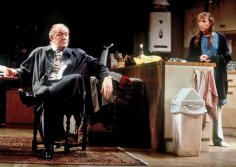 A great actor absorbs us in the moment and convinces us that what we are seeing has never happened before; every possibility lies open. Anthony Sher came on stage at the end of Tartuffe with such a sense of threat that the audience was palpably scared. Michael Gambon and Lia Williams, in Skylight, were so utterly convincing that I could not believe it was possible to repeat the performance the next night. And when Simon Russell Beale was Hamlet, I did not know what he would say next: his thoughts (yes, those famous soliloquies) were pure and clear and real and new.
 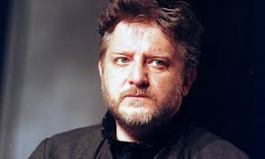 In the theatre, these are the best performances, the most thrilling moments: they are vivid and intense and unforgettable.
On stage, living in the moment is thrilling, it opens us up to new possibilities, it is deeply, profoundly fulfilling and satisfying. I need to harness my inner Russell Beale, embrace the moment. The readiness is all.
 lesleyjonesberry