
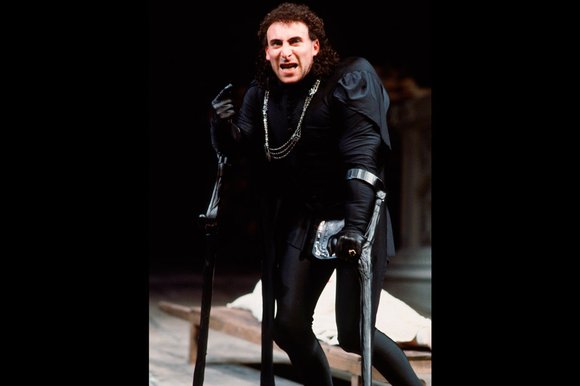
 As I tried to find some way to comprehend the US Election result, Richard III came to mind. I do not suggest that Trump is as evil, or as intelligent, as Shakespeare’s Richard; I wondered rather about the circumstances which allow an individual to become unstoppable in his ascent to power. How does an outrageous campaign, full of bluster and falsehood, confound all reasonable expectation and win?
In my mind, the link between Richard III and recent political events is to do with the breakdown of language. Richard tells lies. He tells blatant shameless lies, denying murder, or admitting his crimes casually as if this has no consequences (there is a brilliant, shocking scene near the start of the play where he woos Lady Anne, despite having killed her husband and her father-in-law (Henry VI)). He blames others (“they do me wrong”); denies responsibility (“’twas thy beauty that provoked me”); nothing is Richard’s fault. His duplicity is shared by his supporters, especially Buckingham, who stage-manages both the setting and the language by which Richard is manoeuvred – supposedly reluctantly – onto the throne as the saviour of a damaged country (“The noble isle doth want her proper limbs”).
Richard displays a quicksilver linguistic skill which makes him very difficult to deal with – he shifts the grounds of the argument, adopts the opponent’s frame of reference for his own purposes, uses shock tactics. And no-one is able to stop him. I remember, as an undergraduate, looking at the language in the play used to address and describe Richard. I found a stark gender split: the women talk of a “bottled-spider”, “hell-hound“, “devil” and “hedgehog“; the men talk of Gloucester and the Duke and even his Grace. This contrast is accompanied by another. The women are articulate but powerless; they can describe Richard but are unable to do anything to block him. The men, on the other hand, wield political power but seem unable to identify the character before them. Buckingham, and others, join him, recognising a vehicle to which they can couple their own ambition. But male characters rarely actually speak up against him – perhaps they refuse to take him seriously until it is too late. When Richard says “if ever I unwittingly or in my rage have aught committed that is hardly borne by any in this presence” (my emphasis) they allow this fabrication to go unchallenged. And when Richard asks the Mayor of London “Think you..that we would, against the form of law, proceed thus rashly in the villain’s death?” the answer is Yes. Yes, we would think that. Because that is what you have done and no “extreme peril of the case” excuses the haste or lack of due process. But the Mayor replies “Your Grace’s words shall serve as well as I had seen”. He takes Richard’s word for it.
In civil life, words have to serve “as well as (if we) had seen”. They have to be fit for purpose, they have to be consistent and retain their meaning from one moment to the next. This is how agreements are made. Decisions taken. Truces brokered. We need to be careful about what we say. When someone says something, we need to be able to believe them. And when language becomes detached from this framework, as it does with Richard, as it did at times with Trump and during the Brexit campaign in the UK, then we are mired in deep confusion. Anything – as we have seen – goes.
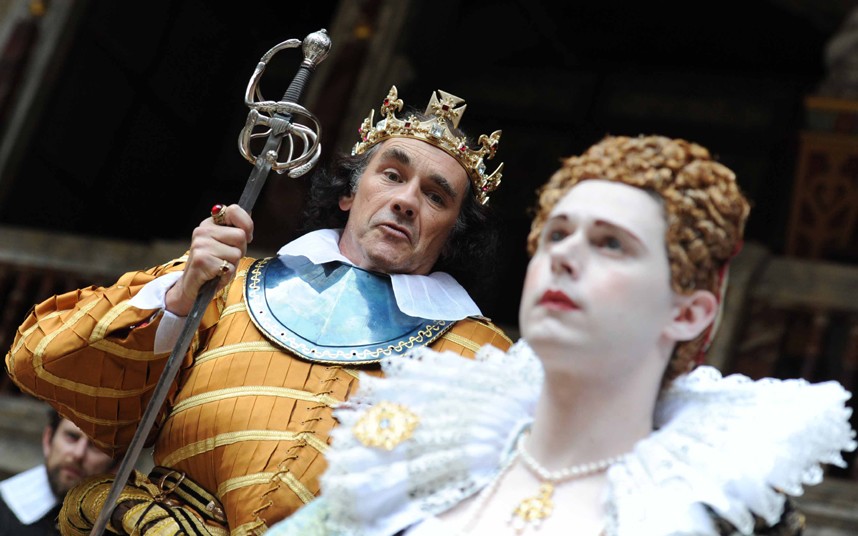 Near the end of the play, some characters are able to put obstacles in Richard’s way. The first is Elizabeth. Having married, then dispatched, Anne, Richard is looking for another political union. He tries to persuade Elizabeth that she should allow him to marry her daughter (also his niece). The scene mirrors the wooing of Anne, but Elizabeth resists Richard’s linguistic forcefulness – I have fond memories of Samuel Barnett, as Elizabeth, impressively matching Mark Rylance’s Richard at the Globe. She blocks Richard by repeatedly anchoring words back in reality.
Richard: “Your reasons are too shallow and too quick”
Elizabeth: “On no, my reasons are too deep and dead,
Too deep and dead, poor infants in their grave”.
Elizabeth resists Richard’s falsehoods; she refuses to be drawn away from what she knows to be true and real. And finally Richmond strides on the stage with a clarity of language which shows him to be the worthy victor before the battle of Bosworth even starts. He alone of all the male characters shares the energy of language – and the animal imagery – which the women have shown. He proclaims Richard “A bloody tyrant and a homicide… A base foul stone”, ”The bloody dog”. Richmond does not only unite the country, he combines linguistic and political power, he unites language and deeds, he reconnects language and reality (“Truly, gentlemen…” ). All of which is necessary.
Jamie Parker wrote about the need for powerful rhetoric post-Brexit. I think he is right. We respond to words not only with our minds but with our emotions. If we are appalled by the linguistic tricks and cheap rhetoric used to win elections recently, then we must reclaim these most powerful of weapons. We have no other tools to use. Like many of us, I would like to walk away from the ridiculous media circus, but we can’t. That’s the way we communicate now. Otherwise, as Jamie Parker says, we are “squandering a vital chance to participate”. In fact, the only way to participate. So what did Richard’s opponents teach us?
- Counter the lies. Call them what they are. Point up the contradictions and demand an explanation. People may change their minds and if so we want to share their reasoning. That’s fine – I like people who learn and think and adapt. But if it is just empty vote-grabbing opportunism, it should be exposed for what it is. A lie.
- Don’t be distracted by counter-attacks and shifts in the argument. Remember the starting point. Ground ourselves in the truth.
- Tell it like it is. And tell it with energy and power and vision. Tell it with rallying calls and stirring words. Tell it to inspire and convince. If we believe we have the better argument, then we must prove it, recouple language and truth, reclaim the power of debate. We need to learn how to tell it so well, so powerfully that “those whom we fight against Had rather have us win than him they follow”.
Richard III is of course only a play, a piece of Tudor propaganda written by Shakespeare to curry favour with Queen Elizabeth, Richmond’s granddaughter. But the character he created was so forceful that it still overshadows the genuine, historical figure. We must never forget: words speak louder than deeds. They always have.
 lesleyjonesberry