
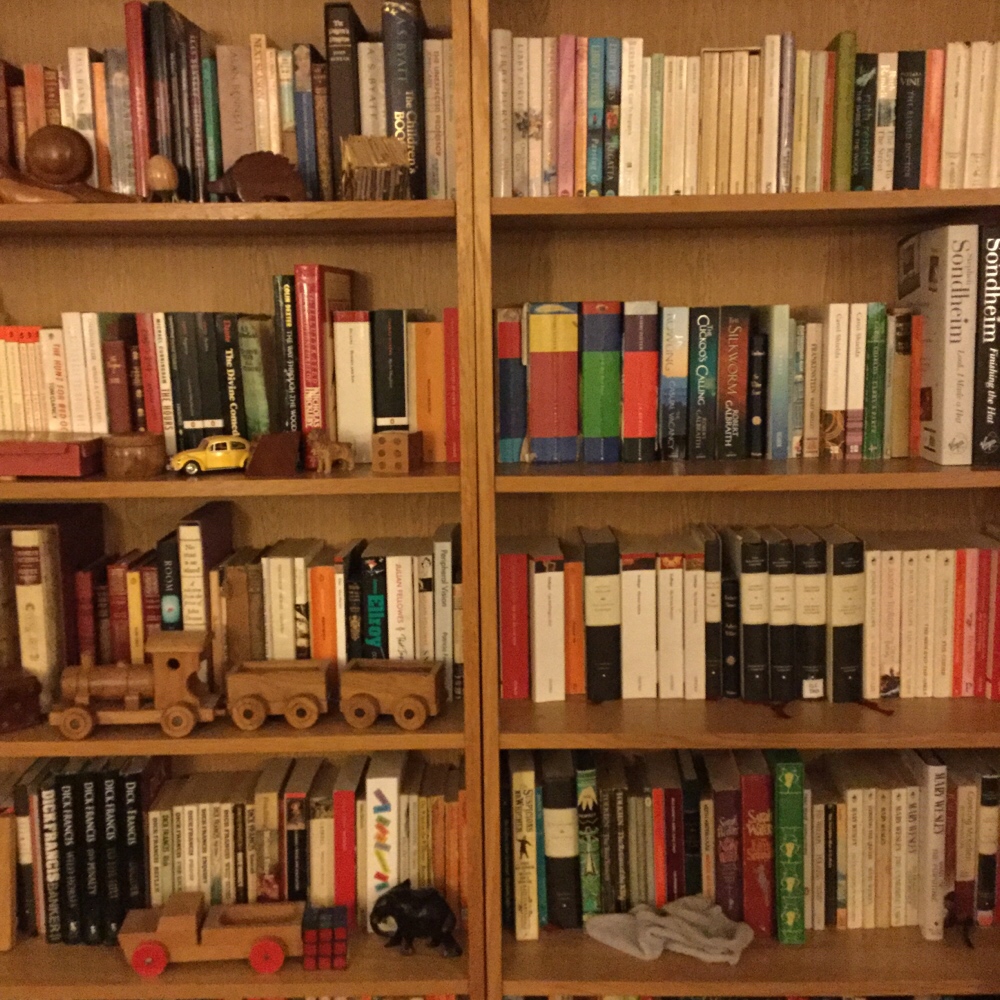
 The house clearance has reached the bookcases. I have known people who say they never get rid of any of their books and feel that disposing of them is somehow diminishing: perhaps we need to keep the physical object in order to retain the information therein. While seeing the attraction of this approach – and with a mix of motives, of which intellectual snobbery is undoubtedly and unattractively one – I assert that keeping all the books one has read is simply impossible. There would be no space left in which to live. Bookcase as bibliography would also be embarrassing: I’ve read any amount of rubbish and, although not ashamed, don’t see that I need to draw attention to it. Besides, keeping books merely as evidence of past reading feels like pinning butterflies to a tray.
I thought I had a clear line on this, and that I had applied it consistently for several years now: try not to buy books for a single reading; use the Library and borrow them; don’t hold on to books which aren’t going to be re-read. In practice, however, I don’t seem to have followed this very well – the shelves were still overflowing with items I could easily discard. The odd hesitation – Captain Corelli’s Mandolin? a fine novel, but having read it at least twice, do I intend to read it again? If I do, does it need to be this particular copy? Move on.
Clearing out redundant possessions is a process of self-defining. There is a temporal, practical element – I do not need to keep things that we have outgrown; I no longer require enough kitchen equipment to feed five as a regular occurrence. But – oh reason not the need – we also choose to retain the things that mean the most to us. Most of what I own is not necessary but luxury. By implication, surely, sloughing off things which are now extraneous means I am defining myself more clearly.
It’s an intriguing process. One image is of the butterfly emerging from the chrysalis: transformed, beautiful, entering a new stage of life. Another, more prosaic, is reduction, like stock, concentrating the flavour so that what is left is purer, stronger, more nearly itself. This is all positive. But my third and most recurring image is of an onion. Layer upon layer is shed, but nothing is essentially different. There is just less onion. How does one know when to stop? If there is no central kernel, will I end up with nothing, just a few odd fragments to shore against my ruins? Or nothing at all – sans everything.
Farcically, I thought about this (while walking the dog), seriously fearing that disposing of too many books would diminish me. I imagined myself in our tiny, essential flat in London, inviting in new people – as I hope to do, as I recognise is necessary once we move – and had a moment of panic that they might not recognise me as a person who reads books. I might become an onion who has lost all its layers.
On my return, I looked at the bookcases again, stripped down to what I felt was the bare essence. Somehow, they were still full.
We may be facing a logistical challenge, but I think a crisis of identity has been averted.
 lesleyjonesberry