
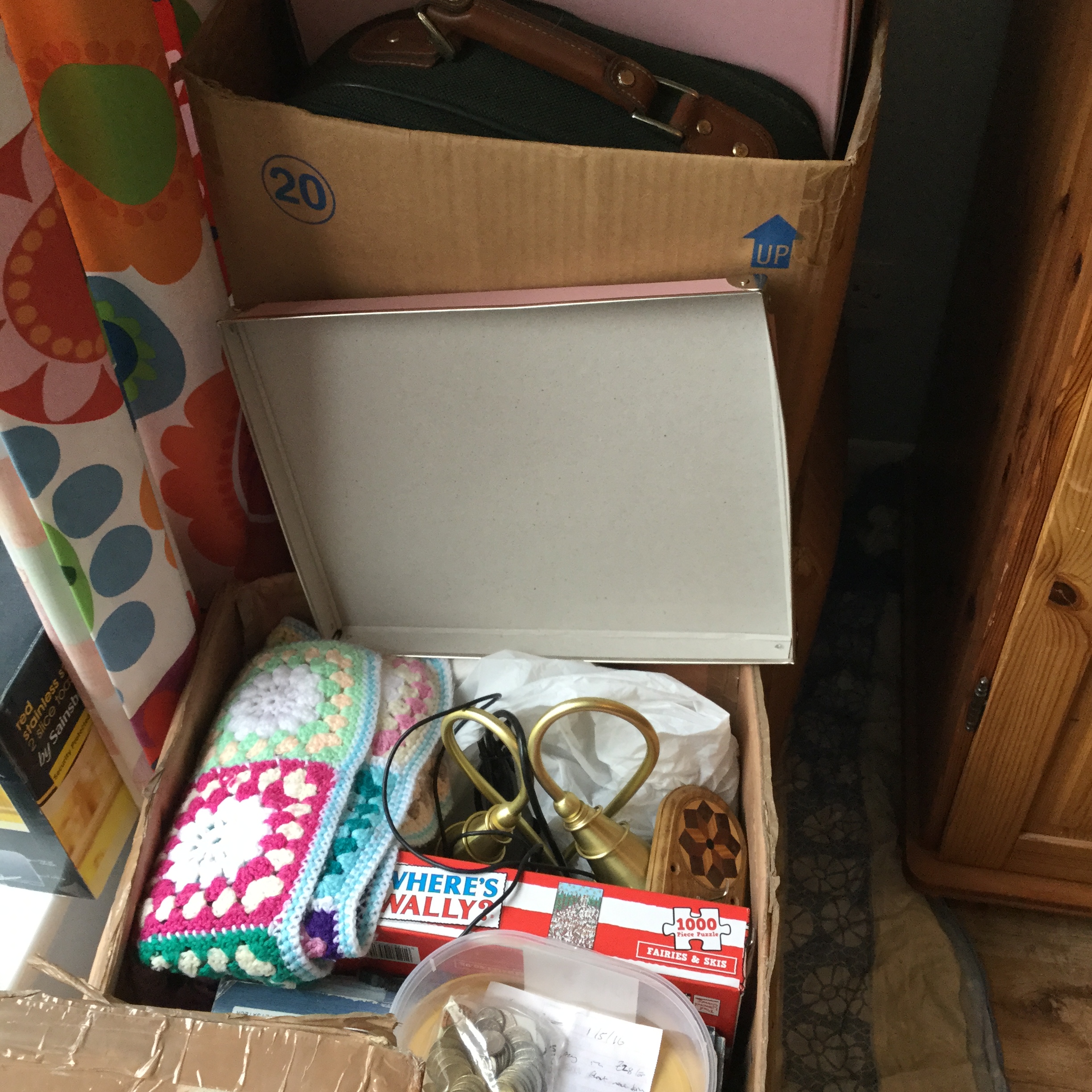
 It is remarkable how much stuff we have accumulated. Things we have been given, things we have bought, things we have inherited, things we have made. Old stuff and new stuff. Some of it well-loved and well-used; much of it incidental, trivial, superfluous, redundant. The contents of this house need winnowing.
I’ve just read 1606 by James Shapiro and so my imagination is strongly coloured by King Lear. I am not sure it is helpful.
Lear, of course, divests himself at the start of the play of his “large effects”. It’s only now, as I check the quotation, that I realise he must, presumably, break up his entire house and household, apart from his Fool and his “reservation of an hundred knights”. The issues of state are so dominant at the start of the play – who gets the kingdom – that the domestic scale only begins to intrude a little later, when Goneril and Regan complain about the behaviour of their father’s retinue and the cost of providing for them. I don’t think I have ever seen a production which points up the practical at the beginning of the play but I would love to see it. An intervening scene, no words needed, with servants carrying plate, packing trunks, loading carts with furniture. As if preparing for a royal progress, with which Tudor theatre audiences would have been familiar, or dividing up an old person’s house as they move into a retirement home – that radical pruning which many members of a modern audience would recognise. Such a mundane, bleak process, sometimes difficult to differentiate from house clearing after a funeral.
Back in my imaginary production, Oswald the steward would make an early appearance, overseeing this action. There would have been three piles and the third would undoubtedly contain the more desirable stuff, Lear being Lear. The King didn’t expect to become itinerant and Cordelia was his favourite, with whom he planned to live: “I loved her most, and thought to set my rest. On her kind nursery”. With Cordelia banished, the older sisters would haggle over this third pile. Goneril and Regan would barter, trading expensive items between themselves, jealous that neither was getting more than their entitlement, while – I can see it clearly in my mind’s eye – certain items would be discarded carelessly. The worn, tatty, much-loved things, of little monetary value but meaning so much to their father. Perhaps … perhaps my imaginary production is becoming too sentimental here … perhaps Cordelia was able to creep on at the end of the scene and gather these up, even produce them near the end of the play, when Lear is found and she arranges for him to be cared for and restored, when they two are reconciled. Of maybe Cordelia has already left for France, and the Fool manages to take just one or two things with him. Items offered to Lear for his comfort in the hovel and destroyed by him in his rage. Proving that he has indeed lost himself.
None of this is strictly relevant for our purposes. We are not disposing of a kingdom, but a house, and we hope to retain our sanity throughout. The flight of fancy into Shakespeare shows two things, however. Firstly – always worth noting and especially after the 400th anniversary events – that Shakespeare continues to offer us the richest imaginative space through which to explore and reflect our own condition. And secondly, that “life is a mingled yarn”. While we may pick out one strand to orientate ourselves – often the practical, containable, task-driven (sane) approach – the rest will be there as well: the emotional and the imaginative, our other senses of who we are and what our life is. From time to time the shifting prism brings these into focus and our experience is the richer. Thus we are not merely disposing of “stuff” in our clearance. We are disturbing our memories and we should allow ourselves space to think and feel, as we choose our identities to take into the future.
 lesleyjonesberry