
 On Wednesday 9th March the Junior Doctors begin another strike. I will be joining them on a picket line. I have never demonstrated against anything in my life before and I have never gone on strike. So part of me is astonished by my own behaviour.
I must declare a personal interest: our daughter is part way through her medical training and will, we hope, become a Junior Doctor in a few years’ time. So part of my response is that of a mother tiger – I feel my child is threatened.
But that’s not the only reason. I have reached a tipping point.
The Junior Doctor’s contract is one more aspect of an approach to the NHS which is damaging and destructive. I believe that the government is already working to damage, undermine and smear the NHS, while privatising what it can quietly in the background. Then they will be able to declare the NHS to be “broken”, having created a context where this seems inevitable and irreversible. This makes me furious.
I suspect that they will attempt to quell protest by offering guarantees: firstly, a medical service which is free at the point of delivery. We know these are subversive, weasel words – my gas boiler service is free at the point of delivery because I am paying a monthly charge, with a contract which has terms, conditions and limitations.
Secondly, free medical care for the disadvantaged (or whatever cunning phrase is chosen). This is a more dangerous chimera but it is the monster I want to fight. It is easy to give examples of someone for whom medical care should be free, and of someone who could easily afford to pay for their own. But it is hard, it is impossible to draw the borderline. Any guidelines are limited and inadequate when applied to the complexities of individual lives. So whatever the rules, individuals suffer in consequence.
Crucially, the people who draw up the guidelines are not the people who expect to receive the free care. The people who draw up the guidelines are (on the whole) better educated, wealthier and this means they draw up guidelines to apply to other people, not themselves. Removal of universal provision divides us. And we care less about “them” than we do about “us”. Of course we do – it’s human nature and the way that familial and social bonds are maintained.
It seems to me that the Conservative approach – in general – is informed by a division, seeing people in terms of “us” and “them”, dressed up with rhetoric of “choice” and of giving opportunities to individuals to cross from one group to the other. Some things are too important for that approach – health, welfare, education. If some people cross over, what happens to the people left behind? It’s not that we are too selfish to care about them, but we don’t care as much about them as we do about us. We are inclined to accept different, lower standards for them. We are apt to feel that, maybe, we deserve better than they do anyway.
The removal of universal provision divides us, and into that division will flood our prejudices and ignorance and assumptions. We cannot allow the government to discriminate and separate out provision. The decisions the ministers make must determine the care given to their own children, to their parents, to themselves at some stage in their lives. We must use our innate self-centredness to good effect by making sure that, in some things – in health, welfare, education – there is only “us”.
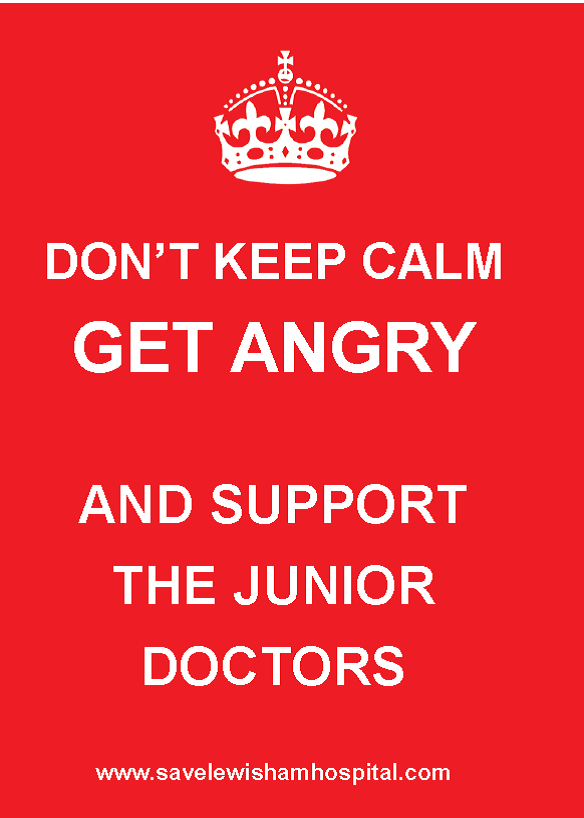 I know that my motivation for protesting on March 9th is fuelled by my own self-centeredness, by the fact that I can imagine each of those Junior Doctors as my daughter. I don’t believe that undermines the validity of my protest, rather it helps me to connect with it. Similarly, I want the NHS to continue and believe we should all want it to continue for selfish reasons. We recognise ourselves to be the patients.
So I will take part in my first political protest. And I will see where this anger takes me. The blog title, by the way, is from Henry V, at the battle of Agincourt. And that battle resulted in a great victory.
 lesleyjonesberry